InterviewsCrypto Casinos14 min read
From Magic Eden to Dicey: Jack Lu’s Next Move in Crypto
Magic Eden reached roughly $100 million in annual revenue before the NFT market collapsed. Jack Lu explains why accepting that decline led his team into crypto gambling, key learnings from Dicey’s beta, and why its next chapter is being built around product, trust and operational restraint.
 Interviewed and written by supr3me22 September 2026


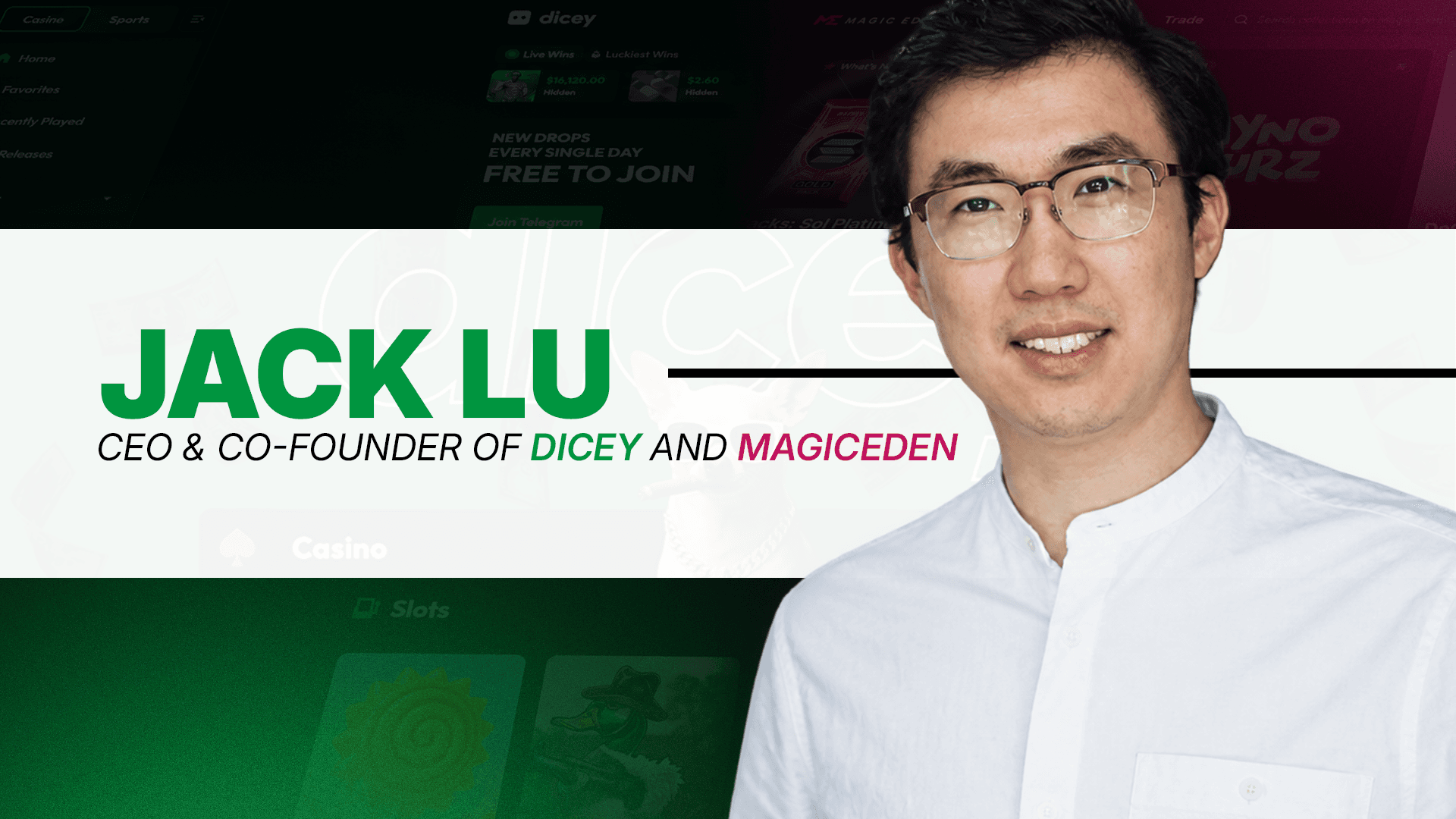
Jack Lu had already watched one frontier turn into a global market before he entered gambling.
Magic Eden began as a side project built at night by Lu and his co-founders. It caught fire inside the Solana ecosystem, became one of crypto's largest NFT marketplaces and, according to Lu, generated roughly $100 million in annual revenue at its peak.
Then the market beneath it collapsed.
Solana fell from about $250 to $8 during the first major downturn. Magic Eden's revenue dropped sharply, recovered during a later Bitcoin-led expansion, then declined again as the NFT market continued to contract. By 2026, Lu estimated that the business had fallen from roughly $100 million in 2024 revenue to around $1 million.
The figures were painful. Accepting what they meant was harder.
Jack Lu: About six months before we started making the decision to work on Dicey, I came to the realization that NFTs were not going to make it.
I was pretty emotional about it. I had probably felt it for a long time, but I was still hoping the market would come back. It didn't.
That moment became the beginning of Dicey, a crypto casino built by a team that understood digital communities and consumer products but had no previous experience operating a gambling platform.
The pivot required Lu to shrink a company that had once approached 200 employees to a core group of roughly 50, explain the new direction to investors and an NFT-native community, and learn the operational side of gambling while real players were already testing the product.
Three months after leaving beta, Lu said Dicey was averaging approximately $20 million in monthly deposits. The early traction matters, but it is not the part of the story he emphasizes most.
For Lu, the central question is whether the team can avoid repeating one of Magic Eden's hardest lessons: fighting over marginal market share instead of building something meaningfully different.
The timeline
2013 to 2014
Lu and technical co-founder Sid enter Bitcoin communities, buy early cryptocurrencies and play sites including PrimeDice and SatoshiDice.
2019 to 2020
Lu begins following Solana and sees an opportunity to combine fast blockchain infrastructure with consumer products.
2021
Magic Eden launches as a side project and quickly becomes a major Solana NFT marketplace.
First year
Magic Eden reaches approximately $100 million in annualized revenue, according to Lu.
2025
The team acknowledges declining NFT revenues and starts building Dicey.
2026
Dicey exits beta and reaches approximately $20 million in monthly deposits, according to Lu.
The instinct to choose the uncertain path
Lu was born in China and moved to Australia during primary school. His father was around 40 when the family moved and had to begin his career again in a new country.
Lu did not understand the significance of that choice as a child. In hindsight, he sees it as the source of an instinct that has shaped his own career: a willingness to choose uncertainty over a future that can be predicted too easily.
Jack Lu: The spirit of taking risks, being adventurous and not settling for a future where you can see it all play out, I got that from my parents.
His childhood was otherwise ordinary. He played basketball, worked hard at school and spent long hours playing StarCraft. Online communities eventually led him into Bitcoin during the 2013 and 2014 market cycle.
Lu and Sid, a high school friend who would later become one of his co-founders, bought Bitcoin, Litecoin and early coins that have since disappeared. They also played some of the first crypto-native gambling products.
The games were simple, but the lesson stayed with him. Crypto was technically interesting and commercially uncertain. Gambling gave the coins an immediate use.
Jack Lu: Crypto was very boring. There were not that many things you could do with your coins, and people would artificially invent things that looked interesting but were often just unsustainable schemes.
Gambling created something fun you could do with the coins. People wanted entertainment, and gambling made crypto work. It was a very good marriage between the two.
Lu's first attempt to join the industry did not happen immediately. Sid moved to the United States and started HelloBlock, a company that indexed the Bitcoin blockchain and sold access to the data through an API. Lu visited, reviewed the business and declined an invitation to join full time because he believed the market was too early and too narrow.
He returned to Australia, worked in consulting, moved into product management at a large technology company and continued trading crypto in the background. He describes turning Sid down as an early source of regret, partly because his friend had taken the uncertain path Lu admired.
Selling a feeling at Magic Eden
The opportunity that finally pulled Lu out of corporate technology was not a trading product. It was the rise of NFTs.
When NFTs began moving from pure financial speculation toward culture and community, Lu saw a product category that fit his background. Solana offered fast transactions. NFTs gave online communities an object around which they could gather, trade and speculate.
Jack Lu: The insight, if there was one, is that it is more important for a product to sell a feeling than to sell utility.
Trading sells the chance to make money. When a product sells a feeling, it can sell fun. That can have much broader appeal.
Magic Eden's early growth came through creators. Instead of acting only as a secondary marketplace, the team worked with creator-led projects on launches, auction structures, phased sales and custom release mechanics. Each creator brought a community with them.
The model worked quickly. Lu said Magic Eden reached approximately $100 million in annualized revenue during its first year.
But the marketplace remained attached to the health of the NFT cycle. When Solana fell from roughly $250 to $8, Magic Eden's revenue dropped by about 90 percent. The business recovered, then regressed again as interest in NFTs continued to fade.
The experience changed how Lu saw the behavior remaining on the platform during the worst periods.
Jack Lu: There was the dream of what we wanted NFTs to be. Once the market died, the reality was that it was gambling with many steps.
You had to get crypto, deposit it into a non-custodial wallet, find Magic Eden and connect everything. People were gambling for the chance that they caught the pump.
The dream had been community and culture. The durable behavior underneath it looked increasingly like speculation.
Accepting that the market was not coming back
For much of 2024 and 2025, Lu still hoped the NFT market would recover. Magic Eden had survived previous downturns, and abandoning the category meant accepting that years of work would not return to their earlier scale.
The emotional break came before the operational one. Once Lu accepted the decline personally, the team began evaluating a new market. Around the time of SBC Lisbon in 2025, Lu and his co-founders studied the gambling industry more seriously.
The overlap was visible inside their own company. Many Magic Eden employees already gambled, and the team had experience building high-volume consumer products in crypto. Investors were willing to hear the thesis, and the company's history made the source of its capital visible to future players.
The transition ultimately became a complete restructuring, not an extension.
Magic Eden had reached close to 200 employees at its peak. The group that began the Dicey journey was closer to 50.
Jack Lu: I told the company that we were going on another zero-to-one journey. I was proud of everything we did for Magic Eden. That journey had been insane.
But I knew that we had to go on another zero-to-one journey. These zero-to-ones take superhuman effort and are not for the faint of heart. Although I was excited by the opportunity in crypto gambling, even I was tired.
That is why I offered our team an opportunity to opt-in or opt-out. For the people who were excited to go again, let's go. For people who wanted to opt out and say they had enough, that also made sense.
Lu described the process as painful but necessary. The smaller group was made up of people who had chosen the new direction rather than simply remaining inside the old company.
Once Dicey was already under development, Lu and the Magic Eden team opted for a harder pivot. The team paired the Dicey announcement with plans to wind down parts of its NFT infrastructure that were losing money.
Jack Lu: Hard choice, easy life. Easy choice, hard life. At some point you have to rip the bandage off, explain the rationale clearly and make the decision.
If we kept the infrastructure alive and prayed for the NFT market to return, we could put the whole company in jeopardy.
Some community members supported the move and became Dicey's earliest testers. Others saw the pivot as an abandonment of the product they had joined.
Lu believes the split exposed a meaningful difference between the two audiences. Crypto traders often look for an edge and identify closely with the technology itself. Many casino players treat crypto as a payment rail for entertainment, accepting that luck and variance are central to the experience.
Once he made the decision, Lu no longer wanted a compromise.
Jack Lu: We had tried many times to make NFTs work. It was time to burn the boats and not look back.
Honestly, I wish I had pivoted earlier. Dicey feels like a new beginning, and things now feel much better than they did during that period.
Building in house after learning the cost of shortcuts
Like most casino operators Dicey uses external suppliers for its game catalog and sportsbook odds. But the team has built out more of the product layer, including its CRM, rewards engine and sportsbook interface.
The choice came partly from Magic Eden, where Lu believes the company relied too heavily on vendors.
Jack Lu: With vendors, it can be short-term gain and long-term pain. We have specific product ideas that we want to build, so we need the flexibility.
It is not the only way to win, but our approach is much more heavily in house.
The founding structure remained collaborative. Lu describes himself, business lead Zed and technical lead Sid as equal co-founders. None had experience operating an online casino when the work began.
That gap shaped Dicey's launch strategy. Instead of immediately spending heavily on acquisition, the company began with roughly 200 users drawn largely from the Magic Eden community, five original games and a deliberately basic product.
The first interface used an off-the-shelf theme and colors users mocked as gray-brown pastel. It was not intended to be impressive. It was intended to expose what the team did not yet know.
It did.
A player noticed that Dicey's blackjack game did not feel mathematically correct. The team investigated and discovered a logic error that prevented queens from being dealt. Lu said Dicey refunded the affected players.
Jack Lu: One of our users said, 'Your cards don't feel right. I shouldn't be playing at this RTP.' He was totally right.
After we discovered it, we refunded everyone. That bought us a lot of goodwill because people could see that we would own up to our mistakes.
The incident reinforced the value of a small beta, but it also showed how quickly a product mistake becomes a question of trust when money is involved.
Learning first, scaling second
The technical error was visible. The operational questions required a different response: observe the patterns, build the data and improve the system as new cases emerged.
Risk management became one of Dicey's first major learning areas. Bonus abuse, advantage play at live tables and sharp sports bets gave the team a growing set of patterns to study. Dicey combined guidance from experienced casino advisers with its own internal data, keeping growth deliberate and staged so each phase produced useful learning before the next.
Jack Lu: We are very confident. We are also learning-oriented in our execution, which is why we are deliberate and intentional about how we grow and make sure we gather the right learnings.
Early on, new patterns surfaced almost every week, and the team worked to separate product issues from normal player behavior. Lu said that now happens closer to once a month. For him, that stabilization shows the learning process is working and gives Dicey more confidence to scale.
Lu applied the same learning-oriented approach personally by taking on VIP hosting, a role most founders would delegate.
The goal was to avoid an ivory-tower view of the business and understand both the player experience and the work expected of the team. In one case, a player he hosted did not feel the experience met the expected standard and stepped away for a period of time.
Jack Lu: It felt like I had messed that one up.
We thought we had done everything right by some textbook formula. The rewards were what they should be, and we delivered what was requested. The player still didn't feel that we were up to the standard.
The player later returned, which Lu credits to the team's work and its willingness to improve the experience.
The experience reinforced how he thought about VIP service. The economics behind the role can be cold: expected value, player value, reward budgets and retention targets. The relationship itself is human, often anonymous and frequently tested only when something has gone wrong.
Jack Lu: You have to be empathetic to how the player is feeling and how things are coming across. We were too utilitarian.
A VIP host has business goals to hit, but in the moment it is a hospitality role. Those things do not always go hand in hand.
The product thesis behind Dicey
Lu's original thesis for Dicey had three broad parts: build trust in a market where players worry about payouts, compete through product in an industry dominated by marketing, and use crypto as more than a deposit method.
The first point is operational. Dicey's team is public, its financial backing can be traced to an established crypto business, and Lu repeatedly returns to the importance of treating withdrawals as a defining moment in the customer relationship.
The second is product differentiation. Lu believes many crypto casinos can succeed without looking meaningfully different because the gambling market is large and continuously replenished with new players. Marketing can compensate for familiar product design.
Jack Lu: I found many of the products successful, but they were very same-same. That reinforced the point that you may not need a very differentiated product to do well if your marketing is strong.
The gambling market is massive. There are always new people joining. In crypto, when the bear market comes, you feel how small it is.
Dicey is taking the opposite bet. Its original games borrow mechanics from hyper-casual mobile games rather than repeating the standard crash, mines and dice catalog. One early example allows players to draw on screen to build a multiplier. Lu described future concepts influenced by games such as Fruit Ninja, where each successful action increases the potential payout until a losing object appears.
The third part of the thesis is crypto-native loan or borrowing technology. Lu wants to explore ways for players to use tokenized stocks, gold or collectibles as collateral without selling the underlying asset first. In that model, Dicey would extend betting power against the collateral.
It is an early idea rather than a released product, and it introduces obvious risk and regulatory questions. But it illustrates how Lu distinguishes crypto infrastructure from simply accepting cryptocurrency.
Jack Lu: Crypto has tried to be many things, and for some of them it is not better than the alternative. The category where it is transformative is money technology.
You could tokenize stocks, gold or Pokemon cards, put them up as collateral and receive betting power. That experience can only be enabled by crypto technology.
Personalizing rewards without rewarding abuse
Rewards are another area where Dicey wants to depart from the standard model. Most casinos assign players to tiers based primarily on wagering volume. Lu argues that volume alone can treat fundamentally different users as if they create the same value.
Jack Lu: Rewards are one-size-fits-all right now. Everyone gets the same experience based on wager volume.
We want systems that understand who the user is and give them a personalized experience that outmatches what they can get elsewhere.
That could mean rewards structured around an individual player's behavior, including personalized streaks, bounties and service levels. The objective is not simply to give away more money. It is to make the reward feel relevant while keeping the underlying economics controlled.
Growing without buying the market
At the time of the interview, Lu said Dicey was averaging around $20 million in deposits each month, approximately three months after leaving beta.
The company had reached that point with limited conventional marketing. Non-VIP acquisition came mainly through organic social content. VIP growth relied on outreach, affiliates and agents. Dicey had some creator relationships but had not competed aggressively for large streamer deals in a saturated market.
Jack Lu: Marketing for us is still going from zero to one. There are not many sexy things to share. We need to do the meat-and-potatoes work, get the engine going, highlight what is different and get louder.
The market will tell us whether it is working.
That restraint is partly strategic and partly defensive. Lu does not want to scale acquisition faster than the operation can learn from new situations. The company is still improving its sportsbook, rewards systems, data quality and customer experience.
Trust, fun, and fairness
Lu summarizes Dicey's long-term product direction through three words: trust, fun and fairness.
Trust means paying players without creating unnecessary friction at the point when the relationship matters most. Fun means producing games and experiences that do not feel copied from the same supplier catalog. Fairness means exploring ways to make the casino's activity more transparent and reduce the feeling that every product is built around the player losing to an invisible house.
One long-term concept is publishing transaction activity on-chain at sufficient scale, allowing outsiders to audit deposits, payouts and game activity. Lu recognizes that previous attempts to put entire casinos on-chain often used blockchain technology without solving a real problem. He believes selective transparency could be more useful once there is enough activity to audit.
Jack Lu: There is always fear in the gambling community about whether the RTP is correct, whether a person was actually paid or whether deposits are fake.
If we have enough scale, putting transactions on-chain and letting anyone audit them could create another layer of trust and fairness.
Dicey is also studying models in which users can provide capital to lottery-style products and receive part of the house edge. The intention is to make the relationship feel less strictly like player against casino.
Building different after Magic Eden
Lu is careful not to predict that product innovation alone will make Dicey one of the largest crypto casinos. The industry already contains well-funded operators, with strong acquisition channels and products that have improved through years of iteration.
His ambition is instead framed around a process: stay close to players, keep the operation controlled and give new ideas enough time to prove whether they deserve to exist.
Jack Lu: At Magic Eden, there were long periods where we were in hand-to-hand combat over the last percentage of market share or the last user. In the long term, none of those things worked. Whereas our biggest growth stories came from when we did something different to the industry and blazed a new trail.
In hindsight, I wish we had focused more on doing the latter rather than the former.
That history is the reason Dicey's slogan, 'built different,' carries more weight internally than a normal marketing line. It is a response to a business that succeeded spectacularly, fought to preserve that success and then discovered that the market itself had moved on.
Jack Lu: In two years, if we have stayed true to bringing real innovation to crypto gambling, the market share will take care of itself.
Success would mean that we made some of these ideas work, not by forcing them on the market, but by understanding what players wanted and doing something different for them.
Magic Eden taught him how quickly a consumer product can catch fire. The NFT market’s decline taught him that a company can spend years defending a category after the behavior underneath it has changed.
Dicey is the attempt to act on that lesson sooner.
Closing note
Magic Eden's market fall left Jack Lu with a decision founders often delay: keep defending the business that had made the company successful, or accept that the market had changed and begin again.
His shorthand for the decision is simple: "Hard choices, easy life; easy choices, hard life. At some point, you have to rip the Band-Aid off."
Dicey is the result of that choice and another zero-to-one journey for a smaller team. This time, it is operating in a market where product mistakes affect real balances and trust is tested at withdrawal.
The NFT market collapse forced the pivot. Dicey will be judged by whether the team can turn that hard choice into a product players believe is genuinely different.