NewsCrypto Casinos4 min read
Engine Expands Beyond Stake as Roobet Adds New Studios
Roobet’s new providers are being delivered through Engine. The rollout shows Stake’s former in-house content ecosystem expanding to outside operators.
 Written by Editorial Desk9 September 2026
Listen to this article
AI narration · 7 min


Roobet announced that 6+ new providers have landed on its casino, naming Donut Gaming, Xposed Studios and Meta Gaming. The post looked like a standard provider expansion. But the new games and provider rollout tell a more important story.
The newly added games are being supplied through Engine, the remote gaming server platform formerly known as Stake Engine. Every title we checked on Roobet connected back to Engine’s platform.
Roobet opens Engine beyond Stake
The providers appearing on Roobet all come from the same content ecosystem. Donut Gaming, Xposed Studios and Meta Gaming were the three names highlighted in the announcement, while Butter Slots, Lucky Labs, Infinity Labs, Krazy Nerdz Studio and Spinify are also live on the site through Engine.
The Roobet games released include Arch Angel, Demons End, Dawn Bringer, Tommy Guns, Twisted Toys, Wild Jester, Moderator Madness and City Nights. Each is delivered through Engine.
The important part is where those games are appearing. Engine was created adjacent to Stake as a way for developers to build and launch directly into its player base. Engine’s developer walkthrough now says studios can “launch on partner websites like Stake,” positioning Stake as one destination rather than the only one. Roobet is the first visible example of that expansion.
Juice is a second provider ecosystem out of Stake
Five game studios previously built around Stake have been consolidated into a new B2B supplier called Juice: Twist Gaming, Knucklehead Syndicate, Monstrums, Massive Studios and The Originals.
Juice offers roughly 100 games through one integration. Roobet’s addition of the portfolio gives those studios a route beyond Stake, where the games were first built and tested at scale.
Juice is separate from the providers named in Roobet’s announcement. Donut Gaming, Xposed Studios and Meta Gaming are demonstrably being delivered through Engine. The five Juice studios sit under their own supplier brand and single integration.
These are the first strategic moves we have seen for the expanding reach from Easygo adjacent companies. With Engine opening the development and distribution platform beyond Stake. Juice is packaging proven, formerly Stake-focused studios into a conventional B2B offerings for outside operators. Both convert content, data and infrastructure developed around one operator into products that can travel across the market.
Stake proved the operator-led RGS model
Stake showed why the model is wildly successful at the operator level. Its Engine platform gave external developers tools to build, test and deploy games directly into an operator with a large player base. Developers are offered a 10% share of gross gaming revenue, while the platform handles infrastructure, deployment and a instant distribution route to players.
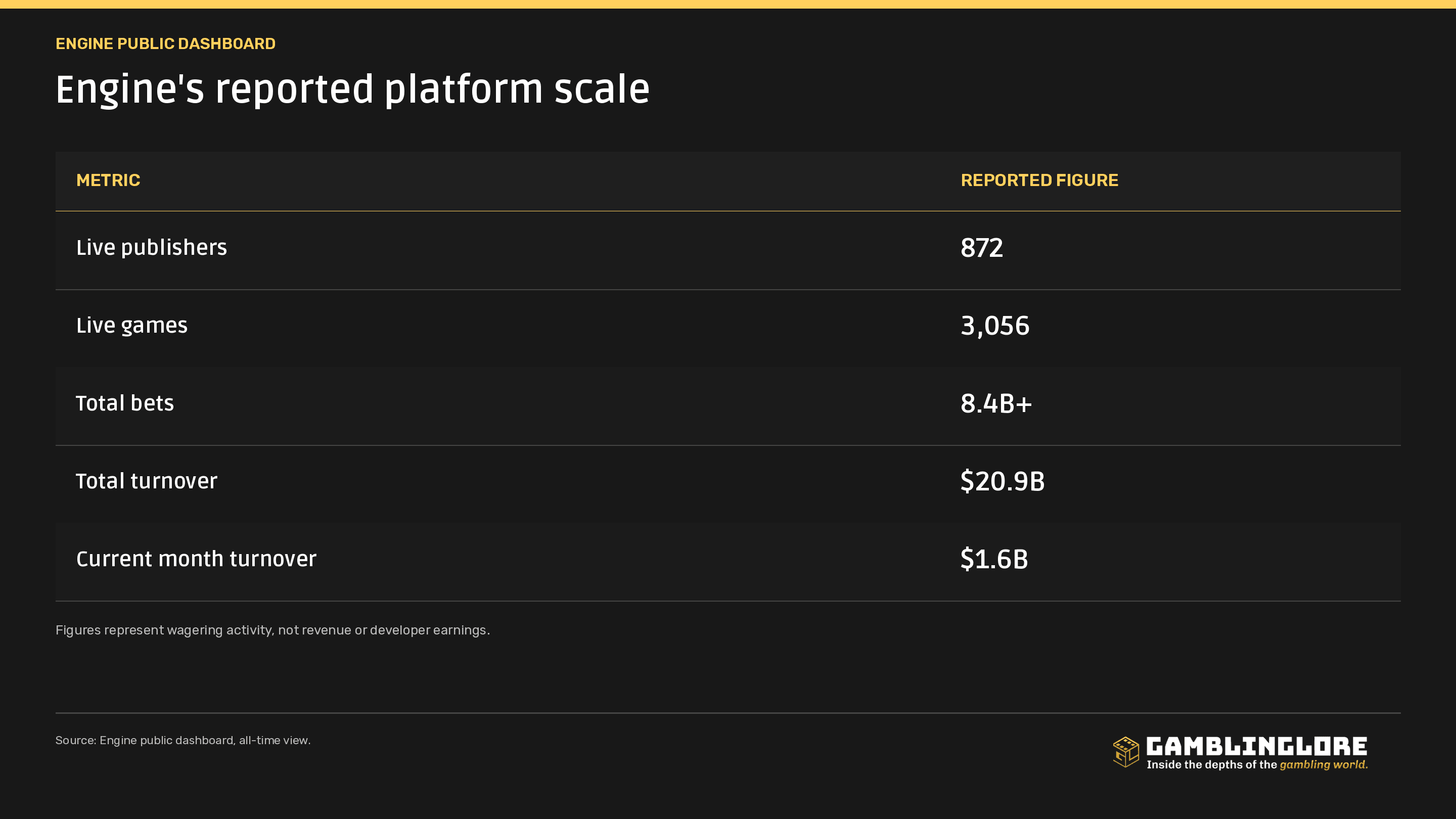
Engine’s public dashboard currently reports 872 live publishers, 3,056 live games, more than 8.4 billion bets and approximately $20.9 billion in total turnover. It also shows roughly $1.6 billion in turnover for the current month.
For studios the advantage was not the the infrastructure provided alone, it was the distribution. A studio could launch into the a market leading platform without first persuading multiple aggregators and operators to carry an unproven title. Stake supplied both the rails and the audience.
Why operators want to own the rails
The traditional supply chain separates the studio, RGS, publisher, aggregator and operator. Every layer solves a real problem, from hosting and wallet integrations to certification, contracts and access to hundreds of casino brands.
A studio builds on tools connected to the casino, tests in the same environment and starts distribution with an audience the operator already controls. The operator can support the release through lobby placement, promotions, affiliates, streamers and first-party player data.
For studios, the attraction is speed and access. A small team can reach meaningful traffic without first becoming a full supplier. For operators, the attraction is control. They gain a faster content pipeline, more differentiated games, better performance data and a greater share of the economics around each release.
Engine’s move onto Roobet shows that operator-led infrastructure can evolve again. The platform can begin as a acquisition, retention and content tool for one casino, then become a supplier to rivals. Juice applies the same logic to the studios themselves by turning a previously captive portfolio into a multi-operator product.
Easygo is expanding its hold on the market
The clearest takeaway from Roobet adding Engine-hosted studios and the Juice catalogue is not simply that operator-led distribution works. It is that Easygo is turning the scale built through Stake into a wider position across the market.
Stake remains the proving ground. Engine takes the infrastructure and creator network built around the operator and opens it to competing casinos. Juice is now a separate supplier, but its five-studio catalogue was also built and proven inside Stake before being packaged for wider distribution.
Together, the moves extend the reach of the content and technology developed within Stake and Easygo’s ecosystem. Even when players are wagering somewhere else, the games or the rails behind them can still trace back to the same network.
That gives Easygo a market hold that goes beyond traffic on Stake.com. Competitors are no longer only competing with Stake for players. They are beginning to distribute products shaped by Stake’s audience, data and infrastructure. Stake’s advantage no longer ends at its own casino.