InterviewsCrypto Casinos9 min read
Inside Gamdom’s Breach: Felix Römer on the Attack and Their Response
Gamdom’s founder, Felix Römer explains the attack, roughly 16 million extracted player records, and a support-system credential missed during the cleanup. Gamdom’s timeline dates initial internal access to October 12 and puts the estimated stolen funds at about $4.27 million.
 Interviewed and written by supr3me31 October 2026


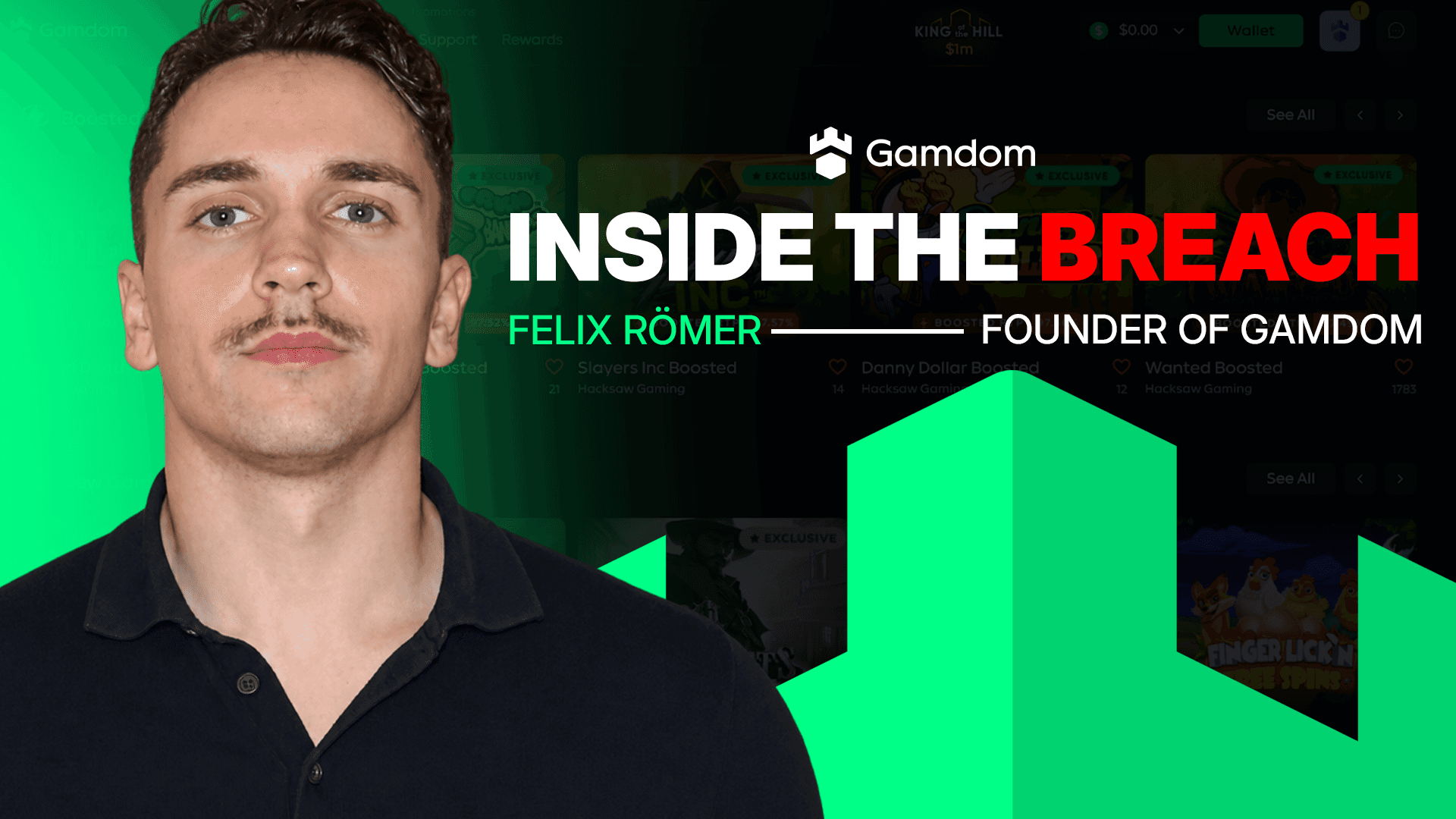
Felix Römer has spent much of the last two weeks overseeing Gamdom’s response to the attack and the investigation into its extent.
The discussion covers the stolen funds, the site’s downtime and the exposure of player and support data. Römer explains Gamdom’s response and which findings were still being investigated.
supr3me: How have you been handling this personally? It’s been two weeks since the attacks on Gamdom started. How do you feel?
Felix Römer: On a personal level, it’s of course frustrating because you think you have all the security measures in place and everything is good. Then, with the hack and downtime, it’s frustrating. You’re not sleeping until things are fixed.
Römer put the stolen funds at about $4.27 million. Gamdom’s team said its review of database logs showed roughly 16 million player records had been extracted, slightly more than the 15.4 million claimed in the public ransom demand on WhiteArmor’s site.
Römer also confirmed the breach through Intercom, Gamdom’s customer-support platform. He said a credential associated with a former head of support had been missed when the team rotated its access credentials after the attack.
The interview follows Gambling Lore’s conversations with the hacker who claims to have extracted the data and WhiteArmor’s founder, whose group published the $15 million demand.
The Timeline of Events
October 12, 21:51 UTC
Internal access. Gamdom says the attacker reached an internal administration service through its staging environment.
October 13, 00:17:45 and 00:19:48 UTC
Credentials stolen. Secret-store credentials were sent outside Gamdom’s systems.
October 13, 03:38–03:48 UTC
Production deployment. A stolen key for an existing deployment integration was used to push changes into production.
October 13, 05:51–06:45 UTC
Session and server access. The attacker reused a stolen session and gained access to production servers.
October 13, 06:49 UTC
Response underway. The team was investigating and rotating credentials during the morning.
October 13, approximately 13:21–13:22 UTC
Bitcoin signing information exported. The attacker exported private wallet signing information.
October 13, 15:21–16:48 UTC
Bulk account exports. Gamdom records user-data export queries during this window.
October 13, 15:51:41–17:40:23 UTC
Withdrawal transfers. Gamdom identifies withdrawal transfers amounting to approximately $4.27m
October 13, 15:55–15:59 UTC
Remote-access software was installed on two production servers.
October 13, 18:24–18:30 UTC
Affected processes shut down. Gamdom says it began shutting down affected processes; withdrawal-queue manipulation was recorded through 18:30.
October 14, 10:54–17:18 UTC
Deployment access revoked. Gamdom uninstalled the compromised integration, revoked its tokens and deleted the application.
October 16, 05:08–06:50 UTC
Renewed attempt contained. Gamdom says it detected and contained another attack attempt, with no new theft identified.
How the Attack Unfolded
supr3me: Take me back to the first sign that something was wrong. When did you first notice someone had access they shouldn’t have?
Felix Römer: The first thing they tried was to get access to our Fireblocks. We mitigated that and were investigating what was going on.
Gamdom’s timeline places initial internal access the previous evening, before the morning alerts Römer described.
According to the timeline of events, the attacker reached an internal admin service through Gamdom’s staging environment at 21:51 UTC on October 12. Credentials were sent outside its systems shortly after midnight. The attacker then used a stolen deployment-integration key to push changes into production and later reused a stolen session to reach production servers.
The timeline supplied for this interview records the team investigating and rotating credentials by 06:49 UTC on October 13. It then shows Bitcoin wallet signing information being exported around 13:21–13:22, followed by bulk account-export queries between 15:21 and 16:48.
Gamdom’s timeline identifies 87 withdrawal transfers between 15:51:41 and 17:40:23 UTC on October 13 and estimates outgoing funds at approximately $4.27 million.
Gamdom’s team stated that the attacker could write to the database to create account balances, then use user accounts to request withdrawals and admin accounts to approve them.
Felix Römer: He got into our Litecoin and Bitcoin nodes and basically drained the money there. It happened quite simultaneously.
The team initially put the losses at around $3 million. The estimate later rose to approximately $4.27 million as the team identified additional losses, including the funds drained from its internal Bitcoin and Litecoin nodes. Some outgoing transfers remain under review.
48 hours offline
supr3me: Walk us through the first hours of Gamdom being down. What was happening while the team worked to bring it back?
Felix Römer: We had devs rotating in shifts so that people could get sleep. And we had a call online for 60 hours in total, just to get everything back up.
Account access and withdrawals were priorities, he said, so customers who felt uncomfortable could retrieve their funds.
Felix Römer: We didn’t want to go online exposing anyone to any risks. So we just decided to stay down longer.
Gamdom’s team said servers were placed into rescue mode to block outside access while secrets and API credentials were rotated. Attempts to use those credentials continued afterward. Römer also described separating services onto different servers as part of the remediation. The timeline records affected processes being shut down at 18:24–18:30 UTC on October 13, with withdrawal-queue manipulation recorded through 18:30.
Römer said he focused on supporting the technical team and identifying ways to strengthen Gamdom’s security.
Felix Römer: I want to help, and the best way I can help is coming up with ideas of how to secure us more.
The timeline Gamdom provided records removal of the compromised deployment integration and revocation of its tokens on October 14. It also records another attack attempt on October 16 that the team detected and contained it, with no new theft identified.
Investigating the Scale of the Breach
Römer said the team initially believed the attacker had retrieved only a small number of accounts, including administrator and moderator accounts.
Later reviewing the activity showed account data being retrieved in batches of 50,000.
Felix Römer: When we looked into it further, we saw that he managed to download accounts in batches of 50,000, and he actually got it.
He says the scale of the extraction became clear after the immediate containment work. Its timeline dates the bulk account-exporting to 15:21–16:48 UTC on October 13.
supr3me: The hacker claims to have 15.4 million account records. Is that the entirety of your user base? Were everyone’s records exposed?
Gamdom’s team confirmed that roughly 16 million records had been exported, slightly exceeding the publicly claimed figure by the extortion group WhiteArmor.
Römer said the changing picture has made communication harder: information the company initially believed was accurate could be contradicted once more of the breach was discovered.
The support credential missed in the cleanup
Intercom created a separate problem. When asked about the hacker’s claim to have support conversations through October 27, Römer said the attacker had used an API credential associated with a former head of support.
Felix Römer: Intercom was a thing that we must have missed, because we thought there was no way for him to get any keys there.
Römer said third-party credentials had been harder to identify and rotate than credentials within Gamdom’s own systems. Gamdom’s team also said the attacker had cracked a weak password hash for an administrator account.
The team had received no security notification about the Intercom data export.
The hacker told Gambling Lore they were extracting 1,791,044 support conversations dated February 24, 2023 through October 27, 2026. Römer indicated that the count and date range appeared consistent with Gamdom’s findings.
Historical KYC files inside support chats
Römer explained that, unbeknownst to him, support staff had processed KYC submissions through Intercom in certain cases to resolve verification issues quickly, including when customers were flagged for suspected abuse that had not submitted documents through the usual verification link. Documents remained in some chats where support agents had not removed them. He added that support records must be retained to meet legal obligations, including responding to law-enforcement requests in investigations involving stolen funds.
Gamdom’s team said most KYC data is now held with that third-party provider and had not been accessed by the attacker.
Felix Römer: End of 2025, we moved over to Verif.
Gamdom’s team estimates that about 4% of its KYC processing took place through Intercom, accounting for approximately 7,000 exposed documents.
From a $50,000 approach to a $15 million demand
In Gambling Lore’s earlier conversations, the hacker had said they reached out to Gamdom administrators but that outreach had gone unanswered. supr3me asked Römer for his account of those approaches.
supr3me: When did they first reach out to you, and when did the demand increase from $50,000 to $15 million?
Felix Römer: It must have been a couple of days after the hack, through Telegram chats and emails, and they were asking for $50,000.
He said the $15 million demand appeared when the claim was published on WhiteArmor’s website.
Felix Römer: It was very poorly written. We thought it was just someone trying to take advantage of the situation and acting like they have something to collect money.
Römer says the person contacting staff used private Telegram identifiers taken from its system. Those direct approaches prompted the team to take the claims more seriously.
Why Gamdom Won’t Pay
When asked about communicating with the hacker demanding payment, Römer questioned what Gamdom would gain from engaging with them. He said their objective was to obtain money and that paying would not resolve the breach.
Felix Römer: I think it’s quite pointless to speak to them, because the reason why they want to speak is because they want to make money.
He also said that a successful ransom demand would give the people responsible an incentive to target other companies.
Felix Römer: Sending them money won’t solve the problem. If they receive money once, they’re going to be incentivized to do this to other people.
Römer described the response as focusing on what Gamdom could change after the data had been taken: securing its systems and requiring password and two-factor authentication updates.
Gamdom’s Security Response
Römer said Gamdom is enforcing password resets and changes to two-factor authentication.
Felix Römer: When you’re now signing in, it asks you to change the password. It also asks you to change the 2FA.
Gamdom’s team is also identifying vulnerable passwords and proactively requiring affected users to reset them.
Römer emphasized that the exposed passwords were hashed, meaning they weren’t stored in a readable form. The team identified weak or reused passwords as a concern.
Gamdom Rejects the MetaWin Link
The hacker had described access to a wider infrastructure cluster and claimed Gamdom and MetaWin shared a vendor. When asked about that alleged connection, Römer rejected it.
Felix Römer: With MetaWin, there’s no relationship at all.
He explained that the attacker had tried URLs containing MetaWin’s name while probing for a vulnerable endpoint. Those requests had not led anywhere and does not establish a connection between the businesses.
The Provably Fair Claims
The hacker had alleged that Gamdom’s provably fair system did not work as advertised and referred to code that could cancel bets above a particular multiplier. They had also said the alleged cancellation code appeared unused.
Römer said the hacker may have confused Crash’s maximum-win cap with a fairness issue. He explained that the cap automatically cashes out large bets when the round’s configured profit limit is reached; it does not cancel those bets or erase their winnings.
He said the cap does not affect the random-number generation used to determine round outcomes, which players can check using the site’s fairness verifier. According to Römer, the cap ensures the return to player (RTP) and expected value (EV) remain unchanged.
Römer disputed the hacker’s separate claim that only 199 accounts showed winnings above one bitcoin, including streamers. He questioned the metric and whether it represented only one wallet or currency.
Gamdom’s team said its log review indicated that the attacker had read the users table, rather than the tables containing betting records.
A warning to other operators
Römer also raised concerns about the wider security risks facing crypto businesses. He suspected AI had helped the attacker and warned that other operators could face similar attempts.
Felix Römer: I really wouldn’t be surprised if this starts happening to other big crypto casinos as well.
Römer’s warning came as other crypto businesses were facing security concerns of their own. Later on October 29, after the interview, Binance said it was investigating a potential security incident. The exchange estimated the total impact at around $6.3 billion, with approximately $3 billion frozen on-chain.
What Players Can Expect Next
The exposed information varied between accounts, from contact details and password hashes to documents submitted through support. With some customers facing a more extensive exposure than others, supr3me asked how Gamdom was communicating the findings to its users.
supr3me: Have you sent emails to users telling them what information was exposed?
Felix Römer: We haven’t sent out emails yet because we are first taking the security precautions.
Römer said email updates would accompany a fuller statement. At the time of the interview, Gamdom was enforcing password and two-factor authentication resets, and working towards customer notices explaining what data had been exposed. He also said the response might extend beyond email.
Closing note
Römer’s account describes the work involved in containing the attack, restoring Gamdom’s services and establishing what information had been taken. He and Gamdom’s team outlined the security changes made during the response and acknowledged where the investigation was still ongoing.
Gamdom is now preparing a fuller statement and customer notifications. For Römer, the immediate priorities have been securing the platform and giving players a clearer understanding of the incident and the steps being taken in response.
Continue reading
- Related Article:Gamdom Hacker and WhiteArmor Speak to Gambling Lore About $15M Ransom
- Related Article:Gamdom Hacker Now Claims KYC Files and 1.79M Support Chats
- Related Article:Gamdom Takes Site Offline After Hackers Drain Over $3M