InterviewsCrypto Casinos15 min read
Rebuilding Duelbits: CEO Jasper on Growth, Version 1.99 and the $7M Hack
After taking over as Duelbits CEO, Jasper faced a $7 million hot-wallet breach and a company-wide rebuild. Jasper discusses his 25 years in gambling, the economics of crypto casinos and the decisions behind version 1.99.
 Interviewed and written by supr3me1 November 2026


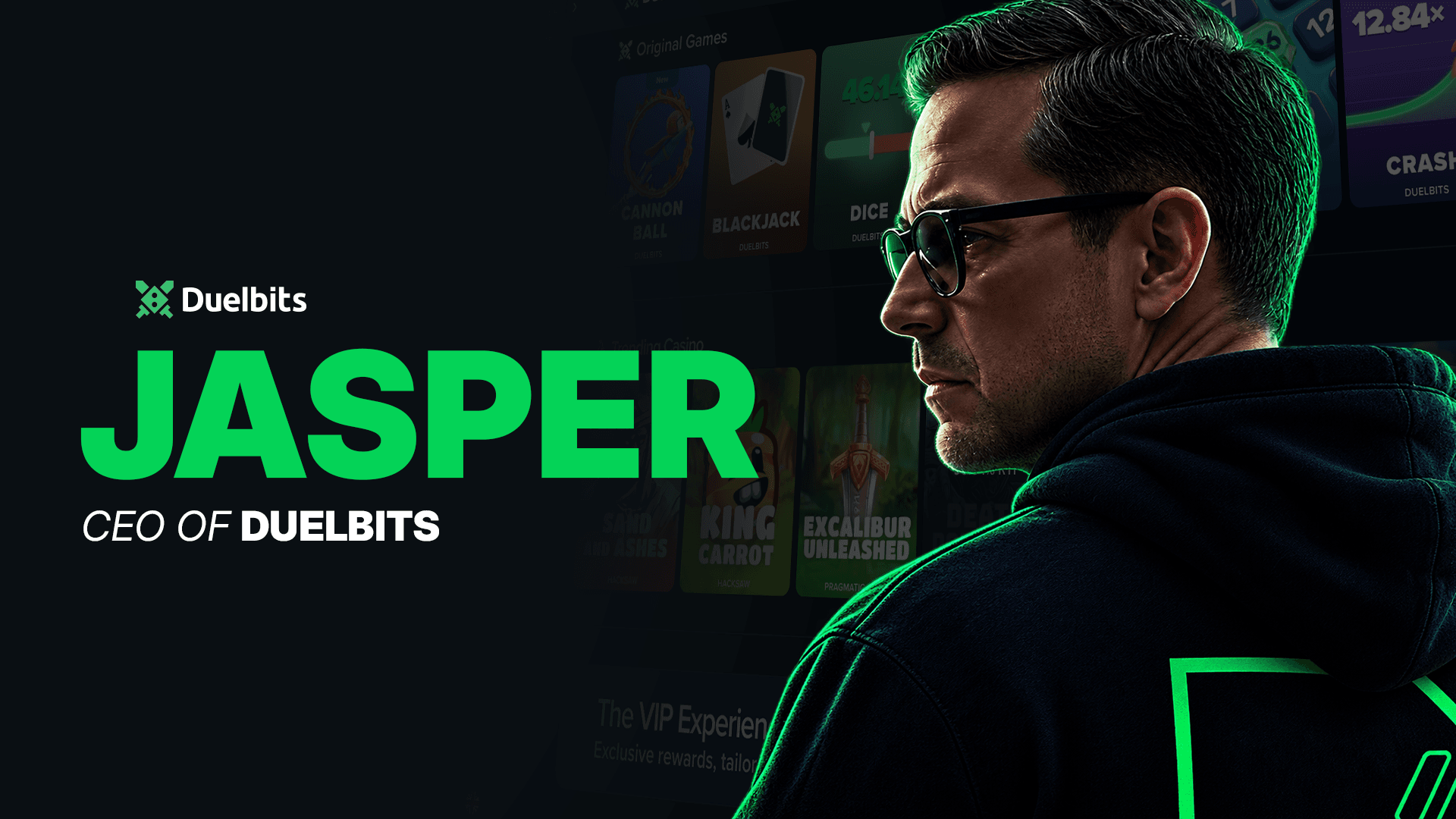
Jasper has spent more than 25 years bringing players to gambling sites and learning what happens after they arrive. His career has taken him from early email campaigns to Paddy Power, Omnicom Media Group and his own affiliate, technology and casino businesses. At Duelbits, he now oversees the operation as CEO.
He joined as CMO, but found that growing the business required changes beyond marketing. In his assessment, Duelbits early success had outpaced parts of its internal infrastructure, while its efforts to reach too many audiences had diluted its focus. Improving acquisition and growth meant addressing product, support, VIP and the way the company worked.
We spoke with Jasper shortly after the launch of Duelbits 1.99 about that rebuild and the decisions behind it. The conversation covers his path into gambling, leading the company through a reported $7 million hot-wallet breach, the economics of streamer deals and why he believes Duelbits has more room to grow.
The timeline
Early 2000s
Jasper enters online gambling through email and affiliate marketing, when customer-acquisition costs were far below today's levels.
2008
He joins Paddy Power to work on online marketing as paid-search advertising for gambling expands.
2011
Joins Omnicom Media Group as Managing Director; heading up performance marketing, focusing on a portfolio of global iGaming brands
2013
Jasper dates the founding of an media & consultancy agency with a co-founder to around 2013. It later expands into affiliate, technology and operator activities.
2014–2015
His agency works with early crypto casinos. He declines offers to accept Bitcoin as payment, citing the practical demands of running the business.
2020
Duelbits launches, initially focused on Counter-Strike gambling before expanding into a broader crypto casino.
Joins as CMO (2025)
Jasper joins Duelbits as chief marketing officer and becomes increasingly involved in wider operational decisions.
After becoming CEO (2026)
Jasper says approximately $7 million was taken from Duelbits' hot wallets shortly after he became CEO. The site remains offline for roughly three days.
October 2026
Duelbits launches version 1.99, introducing a rebuilt interface, technology changes, sportsbook improvements and updated Originals.
From email marketing to online casinos
Jasper said he entered gambling almost by accident. In the early 2000s, he was working with email databases and online audiences. A contact in the United States introduced him to early online casinos, and a test email campaign converted well enough to draw him further into the industry.
Jasper: I’ve always had a fascination for affiliate marketing. I don’t even think at that time it was explicitly called affiliate marketing. It was just: you control an audience and you can make that audience do things.
He recalled trips to Las Vegas, distributing casino chips with bonus codes and getting kicked out of casinos. In his account of those early years, online gambling was still basic, acquisition was inexpensive and operators had more room to experiment.
Jasper said he joined Paddy Power in 2008 as a marketing manager, with a remit to build out its marketing department and digital brand identity. He recalled being there when Google opened AdWords to gambling advertisers and buying traffic from searches for online casinos for roughly 20 cents per visitor. He later led global performance marketing at Omnicom Media Group, where iGaming operators represented a substantial part of his work.
Jasper: Less competition, less pressure on margin, which left a lot more room for innovation from a marketing perspective.
The budgets were substantial, but agency work limited his influence over product and delivery. Around 2013, he founded an agency with a co-founder, later expanding into affiliate, technology and operator businesses. The group also launched a live casino studio in Costa Rica. He said the experience helped him understand how product, operations, marketing and distribution work together.
Jasper: If you control the media, you control the player, you control the brands, you control distribution, then there's a lot of fun things you can do.
The Bitcoin payments he refused
Jasper dated his first work with crypto casinos to around 2014 and 2015. He said the brands offered to pay his agency in Bitcoin and he declined each time. He recalled Bitcoin being worth a few hundred dollars during that period.
Jasper: In hindsight, if I would have said yes once or twice or four or five times, I wouldn't be sitting here. I wouldn't necessarily be doing something else, but I would be sitting differently.
He already owned some Bitcoin and was interested in it, but considered accepting it as business revenue the wrong decision at the time. He had a company and a team to pay, and said using Bitcoin for payroll was not a practical option then.
Jasper: I don't consider this a regret because I still agree with the decision.
He acknowledged the potential financial upside in hindsight, but said the original decision made sense with the information and obligations he had then. He also credited early crypto casino founders with seeing the opportunity more fully and committing to ownership in a way he had not.
Jasper: It's very easy to look at those decisions and say, "Oh, I should have done that differently." But with current knowledge, I think everybody would do things differently.
When marketing cannot fix the product
Over time, Jasper’s approach shifted from acquisition alone toward understanding the full economics of a casino. Even excellent marketing cannot compensate for a poor player experience, ineffective support or rewards that the business cannot sustain.
Jasper: If your product is s***, then you can be a rockstar marketeer, but the value you extract from the marketing will always be limited.
He criticized a familiar cycle: a new operator buys a white-label casino, raises outside capital and spends heavily on bonuses and streamers before proving the business model. Some exhaust their budgets within months, raising acquisition costs for the rest of the market along the way.
Jasper also warned against treating gambling volume and gross gaming revenue as proof of profitability. Publicly visible activity says little about the share returned through rakeback, lossback, affiliates, streamers and other costs.
Jasper: It says nothing about the profitability of the company. It says nothing about the longevity behind those companies. It says nothing about how it's structured.
That does not mean reducing every marketing decision to immediate returns. Jasper argued that operators need both analytical marketers and people who understand the culture of their audience. Optimizing only for directly measurable acquisition can overlook channels where the value is harder to attribute.
Jasper: If you get the culture right, you get the brand right, then the conversion of everything else multiplies.
Taking on Duelbits
The conversation traced Duelbits origins to Counter-Strike gambling and its later move into the broader crypto casino market. Jasper spoke about the history of duelbits saying it launched in 2020 and enjoyed strong early results, but that some of the foundations needed for sustained growth were missing when he joined as CMO.
Jasper: My priority was not so much, How do I scale this? I think it was more, How do I make this sustainable? How do we make sure that this business doesn’t just stay where it currently is, but we prepare it for the next phase of growth?
Duelbits had been targeting crypto-native and fiat-oriented audiences at the same time, spreading its messaging and resources. Jasper wanted to reduce that fragmentation and align marketing with product, support, VIP and finance.
Jasper: It's also an internal vision where the culture needs to change. The way we operate needs to change, and that can only be done if we are aligned.
His move to CEO followed responsibilities that already extended beyond marketing, including VIP. He described Joe, one of the founders of Duelbits, as increasingly involved and central to the brand's identity. Their working relationship is fluid: some areas are left to Jasper, others are led by Joe, and some are handled together. He said his role was to execute their shared plan while respecting the founders' involvement.
Jasper: My job is to execute that plan, but my job is also to be respectful and make the most out of their involvement.
His ambition is to grow Duelbits current volume by removing friction from both the player experience and the way the company operates. He checks performance indicators several times a day, but also treats how people talk about Duelbits as an important measure of progress.
Jasper: I think there’s a lot more positive discourse around us. There’s still work to be done, but to me that’s a massive indicator of things moving in the right way. That comes from culture. That doesn’t come from paid media campaigns or an odds boost on a sports event.
The $7 million hot-wallet breach
Jasper said the first sign of the breach was an alert showing large sums leaving the hot wallets. His initial thought was that he might have missed a big player win, but within seconds the team recognized a problem. The site went offline, the team were all hands on deck and third parties began trying to trace the funds.
Jasper: For us, it’s simply a big hit. But there was never a moment where we thought, “Oh, this is going to ruin us.”
He described protecting player funds, handling deposits sent to saved wallet addresses. The outage also brought lost revenue, the risk of reputational damage and the potential of players moving elsewhere. Looking back, he said Duelbits could have communicated more, but they handled the situation at hand with the information they had at the time.
Jasper: Three days is a long time for a lot of different reasons.
You don't want to cause more fear than needed, but you also need to be transparent.
The discussion turned to what Jasper called an arms race over hot-wallet balances. He said some operators held far more in hot wallets than their withdrawal needs required, partly as a marketing and trust signal. He argued that the industry should reconsider the weight placed on those balances, while stressing that the ability to pay winning players remained important.
Duelbits itself replenished larger hot wallets after the incident as a public statement of resilience. His wider point was that trust should not be reduced to a single visible wallet balance.
Jasper: Trust is more than just your hot wallet. There's a lot more to trust.
Jasper said the breach intensified the urgency behind a roadmap that already covered the next nine to 12 months. He also said the team's response, the founders' support and the eventual relaunch increased his confidence in the business. He emphasized that the response was a collective effort.
Why 1.99 and not 2.0
Jasper described the release as a rebuild of the technology supporting the business as well as the player experience. He said the site feels faster, more seamless and more stable, with a substantially improved sportsbook and polished Originals. The new infrastructure allows the team to ship and test features more quickly.
Jasper: That combination of speed, frictionless play and the new Originals is probably what will have the most impact on the business.
Jasper credited the founders with the thinking behind presenting the release as 1.99: calling it 2.0 would suggest the wider rebuild was complete. For him, there may never be a definitive 2.0, because the product should keep evolving with player data and feedback. He told us that “The job’s never done” and that they’ll keep improving.
Jasper: It's not a finished product. It's a wider change than just a product change.
Jasper said more Originals and a rebuilt VIP program were still to come. Asked about the older roulette and games, he said the team had ideas but it was too early to share much detail. He described a broader ambition to direct more volume toward Duelbits own games.
For VIP, he described a move beyond a traditional, largely loss-driven rewards model toward more dynamic rewards tailored to player segments. Planned features included milestones, improved lossback and clearer information within the player's account. He said some elements had been soft-launched, with a fuller product release to follow.
Jasper: This release has opened the doors to us being a lot more product-first than we've ever been. And that's the dream, right?
Why Duelbits removed prediction markets
Jasper said Duelbits developed its prediction-market product in-house and liked its fit with the brand's audience and content. But it faced both large external competitors and a more immediate question: whether a third vertical added enough to the existing casino and sportsbook.
Jasper: It requires a lot of dedication and focus, and I want to have that focus on our core business, and that's the casino and sports side of things.
The product attracted activity, but Jasper questioned whether it was bringing additional business to Duelbits.
Jasper: You’re also competing with your own liquidity. That was part of our realization. Instead of trying to keep that alive, having it take liquidity away from sports or the casino, it wasn’t additional. It was more cannibalization.
Duelbits had been developing another iteration before reallocating those resources to 1.99. Jasper said the removal was announced without a major campaign. He still likes the product and left open the possibility of revisiting it, but sees prediction markets as a separate third vertical that needs dedicated attention, and for them attention is all on 1.99 for Duelbits.
Hiring people who understand crypto gambling
Delivering that change also depends on finding the right people. Jasper said crypto gambling draws from a smaller talent pool than traditional iGaming, and that experience in the broader industry does not automatically translate into understanding its players.
Jasper: Not everybody lives in Telegram, Discord, X and speaks the language. That takes deep sector knowledge, and that sector is iGaming, but specifically crypto-native iGaming. I think it’s easy to underestimate the impact.
When asked where Duelbits tends to find people with that background, he said the strongest hires often come through the community, existing employees and previous working relationships.
Jasper: Mostly through community, through the people already here, through people I’ve worked with before, through people we’ve worked with before. They’re often the best hires.
Traditional recruiters and LinkedIn play a smaller role. Jasper sees an opportunity for anyone who can solve recruitment in the sector, but believes an overly corporate approach misses the culture these businesses need.
Owning distribution instead of renting attention
Jasper wants Duelbits to put more emphasis on owned content and distribution. He described the Team Liquid partnership as a natural fit with the brand's Counter-Strike history, and said their first custom map had generated engagement and player acquisition. Interestingly their 2nd, GTA themed, CS2 map outperformed the 1st map - without the support from Team Liquid, showcasing that Duelbits’ presence, and legacy in CS is strong.
Jasper: We're very happy with some of the streamers that we have, but we're also realistic that we don't necessarily want to join the streamer inflation arms race.
He said the aim was to control more of the user journey, messaging and distribution rather than depend on third parties. That included content production, partnerships and proprietary games. He still saw a role for paid placements and streamers, but wanted to avoid allowing any single acquisition channel to gain too much leverage over Duelbits.
Jasper: We feel that it makes a lot more sense for us to invest in products and players than it does in investing in overpriced CPA deals, for example.
Jasper emphasized the importance of taste and cultural fit in marketing. He said audiences were increasingly able to spot content that felt fake, inconsistent with the brand or purely transactional. Paid placements could still work, but he considered authentic distribution aligned with the brand especially valuable.
Jasper: True authentic earned distribution that’s on brand, that ticks all those boxes, that’s the holy grail.
Streamer inflation and misleading rewards
Jasper drew on his experience as both an operator and an affiliate to discuss how partnerships have evolved. He recalled that, 10 to 15 years ago, a small group of affiliate partners could account for a substantial share of an operator's new customers.
Jasper: I've worked with brands historically where 70% of all acquisition would come in through a small group of affiliates.
That level of contribution gave those partners considerable negotiating power. He illustrated the commercial dynamic with an affiliate seeking a higher cost-per-acquisition payment because another operator was offering more, alongside a more competitive player offer to retain a leading placement.
For the operator, the challenge was managing that reliance. If a small group of partners supplied 70% of acquisition, changing the relationship without another channel ready could mean losing business it could not readily replace.
Jasper: You don't have a substitute up and running. And you're overly dependent on one single source of acquisition.
He was careful not to apply that historical experience to streamer partnerships generally. He said streamers can contribute more than acquisition, including valuable player insight. For Duelbits, his priority was to build a broader distribution mix so the business could maintain strong partnerships without becoming overly reliant on any single source.
Jasper also linked rising streamer prices to the demands of new venture-backed operators.
Jasper: Every two months there’s another VC-backed operator launching that puts so much pressure on their acquisition team and just tells them, “Onboard five of the 50 biggest streamers and whatever they want.” That increases the prices, and then the next month somebody else will do that.
The conversation also covered streamers borrowing money to gamble.
Jasper: I think loan culture is toxic as f***.
He criticized large headline bonuses and rakeback claims whose restrictive terms made the advertised value unrealistic for most players. He said that could leave newcomers with a poor first experience of the industry. Describing Duelbits approach, he expressed a preference for clear, cash-based rewards and said relevant free-bet offers carried wagering requirements averaging roughly two to four times, with limitations made clear.
Jasper: I don’t like a lot of noise. I don’t really like a lot of small print. They’re hard to manage, they’re hard to work with, and they cause friction.
On promotional balances, Jasper distinguished their use in content from presenting them as real money. His objection was to misleading viewers, and he said creators should acknowledge when a balance was fake.
Jasper: I don’t think fake balance is necessarily the issue. I think passing it off as real balance is an issue.
The pack opening trend
Jasper is interested in gacha and card-pack opening products, but remains uncertain about their staying power. He said they were drawing liquidity away from casino products, while acknowledging that his expectation of that liquidity returning could prove wrong.
What gives him pause is the similarity between many entrants. He described much of the activity as another wave of white-label launches with limited differentiation, calling that an orange flag rather than an outright reason to reject the category.
Jasper: I like it, but a lot of people I've seen moving into that space, it all feels sort of like the next white-label thingy. I don't see a lot of actual uniqueness.
When the conversation turned to intellectual property owners, he said he would be surprised if they took no action as these products became more visible. He expected the association with their brands, and the commercial opportunity, to attract attention. Whether that would mean restrictions, greater control or another response remained an open question.
Jasper: I'd be surprised if they do nothing. They care about the visibility of it because then they'll be associated with it. When that happens, I do expect them to take action.
The new economics of casino competition
Jasper argued that thinner margins have made volume increasingly important for supplier negotiations, variance management and the business's runway. He said he had previously spent much of his time optimizing margins, but now saw a stronger case for doing so alongside clear volume ambitions.
Jasper: The big thing that has changed is the thinner margins, and it has very much become a volume game more than anything else.
Volume allows you to negotiate better deals with suppliers. Volume allows you to manage variance better. Volume allows you runway as well as a business.
He also discussed controlling more of the value chain, from technology and games to brands and distribution. Looking back, he said he had underestimated how important volume and that control would become as margins narrowed.
Can a small operator compete
Asked to compare an experienced operator starting with $100,000 against a venture-backed entrant with $20 million but little knowledge of crypto gambling, Jasper initially gave the larger bankroll a better chance of survival.
Jasper: He cannot absorb a single big mistake. One bad media partner and you're done. I think the second one has the luxury of having the money to make mistakes and to learn from those mistakes and pivot.
But the scenario changed: what if the smaller operator understood those risks, kept betting limits low and focused on building a loyal community, while the larger entrant continued spending aggressively? Under those conditions, Jasper favored the smaller business.
Jasper: I still think it's possible to make noise and have an impact even with a smaller bankroll. Because it's so targeted and so segmented, you can do a lot more with intelligent revenue-share deals, intelligent distribution plays.
He said keeping the business small could limit exposure and supplier costs, while AI could make development more affordable. Understanding the audience, distribution and the risks to avoid mattered more than simply having a large launch budget.
Early success, however, would bring another decision: how to expand without losing the discipline that made the business work.
Jasper: The big question is what happens after, right? You're going to want to do more, and that's where the next risk window comes. You've done something successful and then you think you can just build on top of it, but whatever you build on top of it needs to make sense, needs to be right.
Closing note
Jasper is leading Duelbits alongside its founders to the next chapter. He sees 1.99 as the foundation for that growth, with more product-led additions across Originals and a rebuilt VIP program still ahead. His challenge is to turn the changes behind the scenes into an experience that gives players a reason to choose Duelbits and stay.
He watches the numbers closely, but also pays attention to how players and the community talk about the site. For him, building the next chapter for Duelbits has to come from how the business operates, with alignment across support and VIP to product and marketing. That is where his ambitions for the rebuild will meet players' expectations.
Continue reading
- Related Analysis:Duelbits Analysis: The Strategy Behind the Rebuild