NewsCrypto Casinos4 min read
Florida AG Sues Stake Over Sweepstakes Gambling Claims
Florida Attorney General James Uthmeier has filed lawsuits against Stake and VGW, alleging their sweepstakes platforms constitute illegal gambling operations
 GamblingLore Editorial Desk20 August 2026


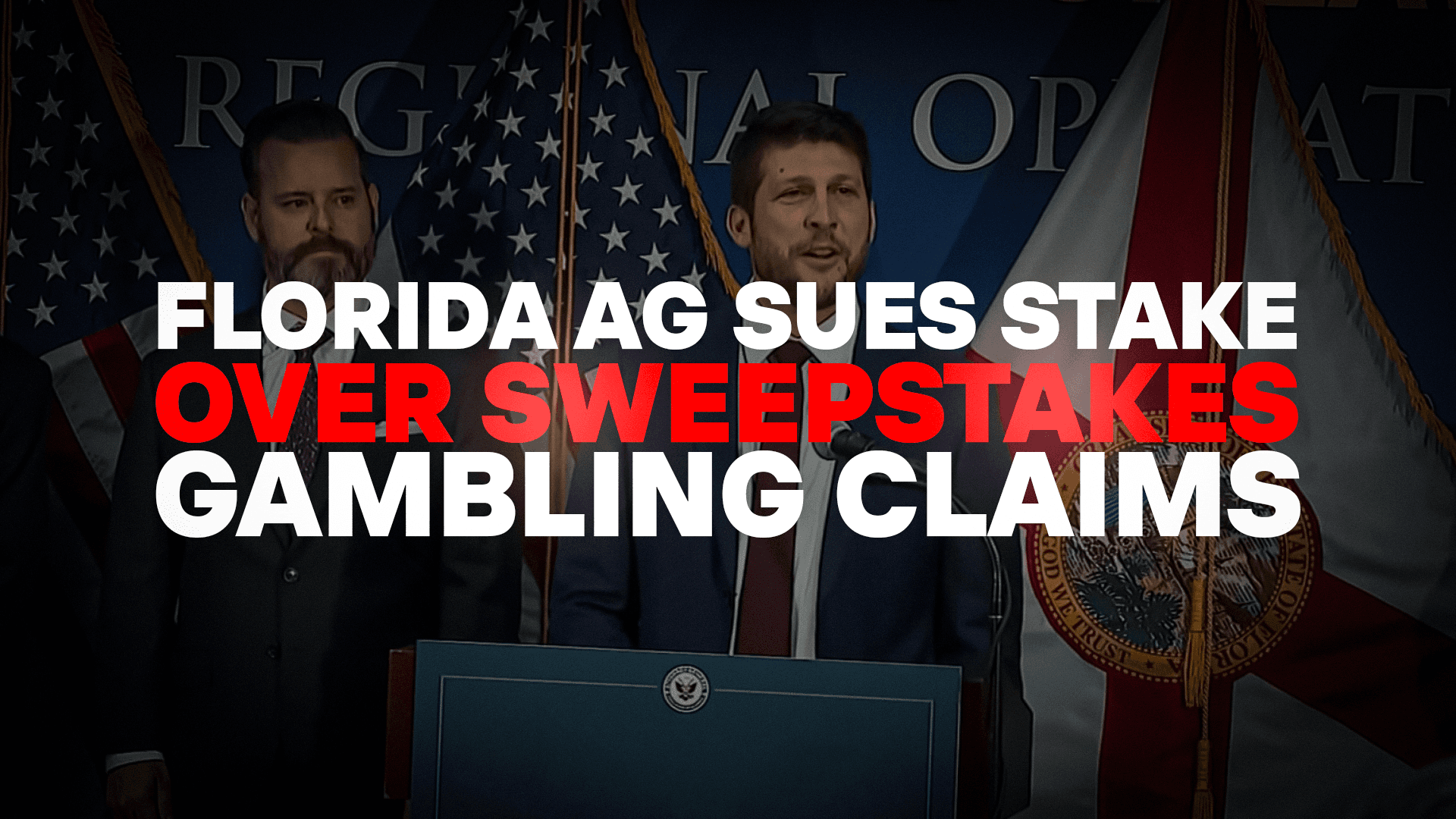
Florida Attorney General James Uthmeier has escalated the state’s fight against sweepstakes casinos, filing lawsuits against Stake and VGW alongside several companies involved in processing payments for their platforms.
The two complaints were filed on August 19 in Hillsborough County Circuit Court. The cases target Stake.us and VGW’s Chumba Casino, LuckyLand and Global Poker brands, with the state alleging that the platforms operate as illegal online gambling businesses and violate Florida’s consumer-protection laws.
The lawsuits represent a significant escalation in Florida’s scrutiny of the sweepstakes sector. Rather than targeting only the operators, the state has also brought payment infrastructure into the litigation, potentially creating broader implications for companies that service sweepstakes platforms.
Florida challenges the sweepstakes model
At the center of the lawsuits is the dual-currency model used by sweepstakes casinos.
According to the complaints, customers purchase packages containing non-redeemable virtual currency — typically Gold Coins — alongside a second currency that can be used to play casino-style games and potentially redeemed for cash or other value.
In Stake’s case, that currency is Stake Cash. The state alleges that customers must wager Stake Cash three times before being able to cash out.
Florida argues that describing the redeemable currency as a promotional or free component does not change the underlying economic transaction and that the platforms are effectively offering real-money gambling without the licenses required under state law.
The complaints also allege deceptive conduct under the Florida Deceptive and Unfair Trade Practices Act (FDUTPA).
Uthmeier has taken a particularly aggressive position on the issue, arguing that the sweepstakes designation does not distinguish the platforms from conventional online casinos.
“If it looks like a casino, takes real money like a casino, and pays out like a casino, it is a casino—and it is illegal under Florida law.”
The Attorney General’s office is seeking to prevent the companies from operating or soliciting customers in Florida, as well as recover money allegedly lost by Florida consumers. The complaints also seek restitution, disgorgement, attorneys’ fees and civil penalties.
Payment processors pulled into the case
Perhaps the most consequential element of the lawsuits is Florida’s decision to name payment companies alongside the operators.
The Stake complaint names payment-related companies including Praxis and Breeze Labs Payments, while the VGW case names Worldpay and Trustly, among others. The state alleges that these companies facilitated the financial transactions necessary for the platforms to operate.
The distinction is important.
Rather than treating payment providers as peripheral businesses simply processing transactions for an operator, Florida’s complaints seek to connect the movement of money directly to the alleged illegal gambling activity.
That could create a significant precedent for the broader sweepstakes industry if the state’s theory succeeds.
Payment processors frequently service multiple operators. A finding that processors can face liability for facilitating transactions on sweepstakes platforms could therefore increase the compliance and legal risk associated with servicing the sector, even for companies that do not operate the games themselves.
The approach also gives regulators another potential avenue for restricting platforms that operate through offshore entities, particularly where their payment infrastructure relies on companies with a substantial US presence.
Florida moves without a new sweepstakes ban
The lawsuits are notable because Florida lawmakers did not enact a dedicated sweepstakes casino prohibition during the state’s 2026 legislative session.
Instead, Uthmeier is attempting to use existing gambling and consumer-protection statutes to challenge the industry’s dual-currency model. Florida’s broader gambling legislation failed to advance after lawmakers were unable to finalize an agreement before the session ended.
The legal strategy therefore puts the existing statutory framework to the test: whether Florida’s current gambling laws are sufficient to classify sweepstakes casinos as unlawful gambling operations without the legislature first creating a specific prohibition.
That question could make the cases particularly significant beyond the individual defendants.
Part of a broader US crackdown
Florida’s lawsuits arrive amid a rapidly changing regulatory environment for sweepstakes casinos across the United States.
More than 20 states have issued cease-and-desist orders against sweepstakes operators, while at least 17 states have either banned or materially restricted the dual-currency model. Several states, including Connecticut, Montana, New Jersey, New York and California, introduced targeted legislation during 2025, while additional restrictions were adopted in 2026.
Florida’s approach differs in one important respect: the state is attempting to establish liability through existing law while simultaneously targeting the financial infrastructure supporting the operators.
The cases could therefore become an important test of how far state regulators can extend enforcement against the sweepstakes ecosystem.
For Stake, VGW and the wider industry, the immediate question is whether Florida’s courts accept the state’s characterization of the dual-currency model as gambling — and whether that theory can extend beyond operators to the companies that enable customers to deposit and withdraw funds.
The lawsuits remain allegations at this stage, and the defendants will have an opportunity to contest the state’s claims in court.
But regardless of the eventual outcome, Florida’s decision to pursue both operators and their payment infrastructure signals that the regulatory battle over sweepstakes casinos is moving beyond the question of how the products are marketed and toward the entire ecosystem that allows them to operate.