NewsSports Betting3 min read
Gen Z Is Starting to Treat Sports Betting Like an Investment
More young adults are blurring the line between investing and gambling, with Gen Z increasingly putting money meant for long-term investments into sports betting.
 GamblingLore Editorial Desk17 August 2026


A new survey from Betterment highlights just how much the line between investing and gambling has blurred for younger Americans, with Gen Z increasingly treating sports betting as something more than entertainment.
According to the survey, 26% of Gen Z investors say sports betting is a deliberate part of their long-term financial strategy, compared with 14% of millennials, 6% of Gen X and just 1% of baby boomers. Overall, only 12% of investors said they viewed sports betting this way.
The more striking figure is how many have actually moved money between the two. 52% of Gen Z respondents said they had redirected money intended for investing toward sports betting at least once over the past year. That compares with 31% of millennials, 10% of Gen X and 4% of boomers.
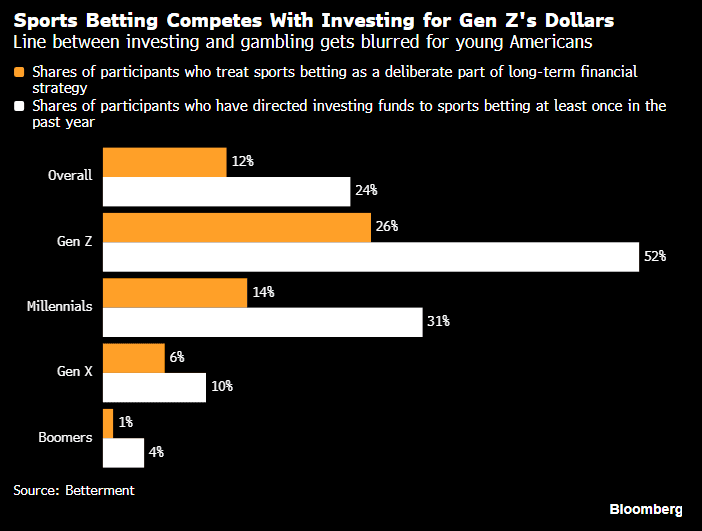
The findings were highlighted by Bloomberg's Eric Balchunas, who described the trend as Gen Z moving money from stocks toward sports betting in their wealth plans.
The survey does not establish how much money was moved, meaning the 52% figure should not be interpreted as 52% of Gen Z investment capital flowing into sportsbooks. It does, however, point to a meaningful change in how some younger investors think about the two activities.
Sports Betting Is Competing for the Same Wallet
For decades, investing and gambling occupied clearly different categories in the consumer's mind. Investing was about building wealth over years or decades, while gambling was primarily entertainment.
That distinction is becoming less obvious.
Sports betting platforms and financial apps are increasingly converging in both design and behavior, with each borrowing heavily from the other’s playbook. Modern betting apps now mirror brokerage platforms, allowing users to track “positions,” monitor live odds movements, manage bankrolls, and execute rapid-fire decisions in response to breaking information, features that closely resemble active trading dashboards.
At the same time, financial products like Cero have introduced gamified spending mechanics that blur the line between consumption and play. Push notifications turn everyday purchases into real-time feedback loops, reward systems that give "packs" back on spending, weekly jackpots, and "cero score" which encourages continued activity. This is creating products where financial literacy was once divided from the casino, but not the lines are blurred for consumers and hyper-gamblification is taking the market by storm.
The Industry Has Already Changed the Way Betting Is Presented
Sports betting's evolution has also made the activity increasingly embedded within everyday financial and sports culture.
Sportsbooks are no longer confined to physical casinos or betting shops. They sit alongside banking, brokerage and payment apps on smartphones, while betting information is distributed through the same social platforms where younger consumers consume financial news.
Gen Z is particularly exposed to that convergence. Betterment's survey found that 60% of Gen Z investors rely on social media for financial news, compared with 35% of investors overall.
At the same time, sports betting itself has become increasingly mainstream. A 2026 Siena Research Institute survey found that 27% of Americans have an active online sportsbook account, rising to 52% among men aged 18-49.
The result is an environment where financial information, sports content and betting opportunities increasingly occupy the same digital ecosystem.
The Blurred Line Between Betting and Investing
The similarities in user experience should not obscure the fundamental difference between the two.
Investing in productive assets gives investors exposure to businesses and economic growth over time. Sports betting is a wagering activity in which the bettor generally faces a structural disadvantage through the sportsbook's pricing and margin.
MarketWatch's reporting on the Betterment survey emphasized precisely this distinction, noting that investing is designed around long-term wealth accumulation while gambling is a negative-sum activity for bettors as a whole.
The concern, then, is not simply that young people are betting more. It is that some are beginning to classify betting as an alternative wealth-building strategy.
That distinction becomes particularly important when money originally earmarked for long-term investing is being redirected toward wagers.
A New Generation of "Investors"
The Betterment findings should not be interpreted as evidence that an entire generation has abandoned stocks for sportsbooks. The survey covered 1,000 U.S. investors divided across four generations, and the Gen Z sample represents only a portion of that group.
Gen Z is substantially more likely than older generations to view sports betting as part of a long-term financial strategy, and more than half of Gen Z respondents reported moving investment money into sports betting at least once.
The more significant story may therefore be less about gambling itself and more about how younger consumers conceptualize risk, wealth and financial opportunity.