InsightsIndustry8 min read
The Low Barrier Problem: When Launching a Casino Is Easier Than Running One
Through a $400,000 player dispute, a firsthand casino owner account and the real cost from these white-label providers, Gambling Lore looks at what happens when access to casino platforms is easier to access than the ability to run it.
 Written by blinded6 September 2026


Entering the online gambling industry used to carry some more substantial barriers. Building the technology, securing the necessary infrastructure, establishing payment relationships and developing the operational expertise to manage a gambling business required significant capital, time and industry experience. Those requirements naturally limited the number of operators able to enter the market.
There has been a constant stream of new operators launching almost every week. The barrier to entry into the gambling industry is at an all time low, and it is becoming increasingly evident that many are entering the market without the operational foundation or expertise needed.
A large part of that change can be attributed to the growth of white-label solutions. An operator no longer needs to build an entire platform, integrate every game, develop its own back office or establish much of the underlying infrastructure from scratch. Much of the stack can be provided by third party providers, allowing a new brand to move from an idea to a live gambling operation in a fraction of the time and at a fraction of the cost historically required.
Licensing from offshore gaming commissions has become more accessible with jurisdictions offering straightforward routes for operators to obtain a license and access service providers. White label providers take this a step further by offering the full suite of what is needed to launch including master licenses, game aggregation and other core infrastructure. That combined with the lack of a single regulatory standard across the global online gambling market makes accessing these solutions easier than ever to enter the industry and in most cases means almost anyone can get into the market.
The result is an industry where new operators are popping up and closing almost daily. When the market is flooded with the same products, it only widens the gap between challenger brands and established market leaders that already have the operational experience and reputation needed to retain players and provide a safe gaming experience.
This does not inherently make the white-label solutions, accessible licensing, or all new operators problematic. These developments and services have lowered the cost of innovation and allowed legitimate businesses to enter the industry. But the concern is what happens when the ease is accompanied by inexperience to operate responsibly.
Bluff: A $400,000 Dispute After One Session
This case shows that money raised is not a clear signal that an operator has the experience to fairly handle player disputes. The dispute involving Bluff shows how quickly those shortcomings can put player funds at risk.
According to the player, @PeterKolui, he joined Bluff through a referral involving two friends. All three were separate people, but they played similar amounts and used similar strategies. That overlap appears to have become part of the dispute.
During his first session, the player deposited $200,000. Bluff also offered a deposit top-up. The player says he accepted the offer, although it remains unclear whether the top-up was ever credited or used. After playing several games, he moved to Pragmatic Live Blackjack, placed bets of up to $100,000 and increased his balance to roughly $600,000 in less than 15 minutes.
Inside the 15-minute session
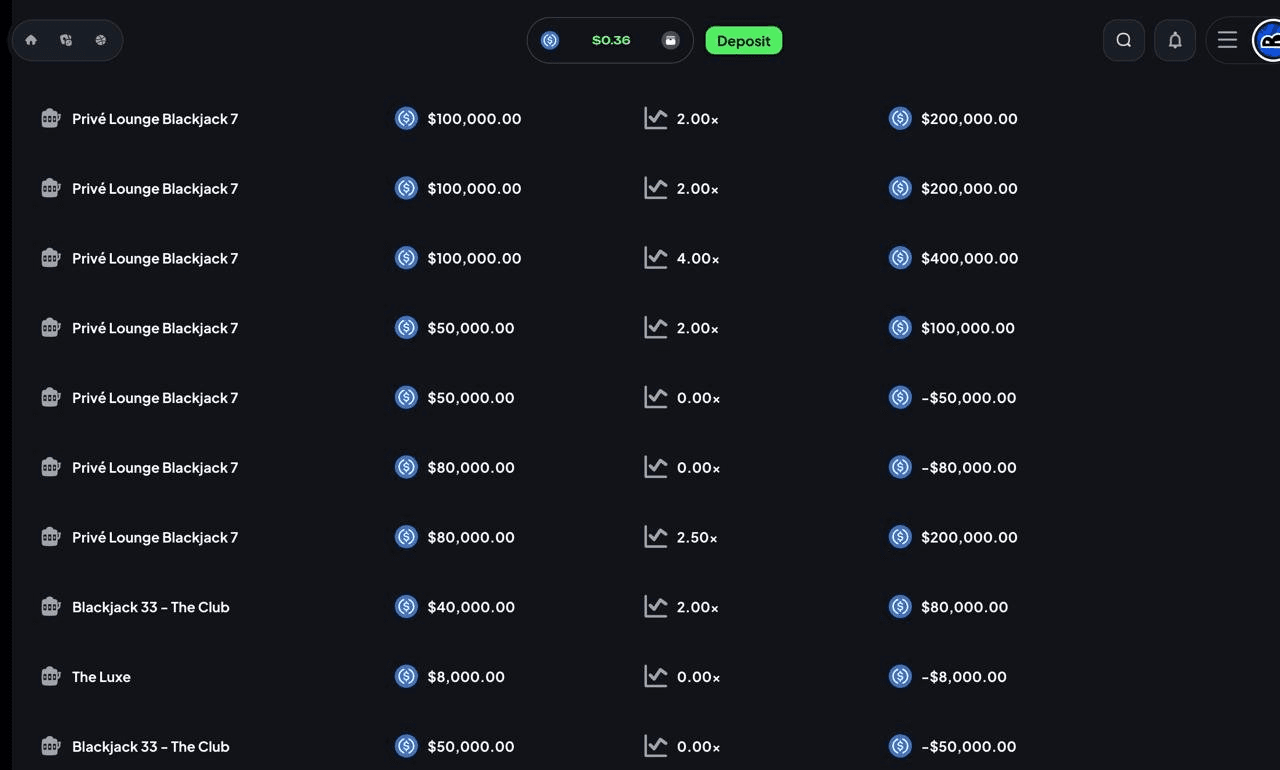
When he requested a withdrawal, Bluff cancelled it and began reviewing the play. The casino processed his original $200,000 deposit, while the remaining $400,000 in winnings stayed in his account balance.
Bluff first requested KYC from the player, which he says he completed successfully. It also requested KYC from the friend who referred him, despite that friend not having played there for weeks. According to the player, Bluff then said Pragmatic Play needed to conduct a “gameplay check” and presented that review as the reason for the delay.
After roughly six weeks, the player received a legal email saying Bluff was seizing the $400,000 in winnings for breaching its terms. The stated concerns included platform or bonus abuse and “account-association indicators.” The player disputes those claims and says the accounts belonged to three separate people connected through referrals.
When the player asked what “account association” meant and what conduct he was being accused of, Bluff’s VIP Support said the indicators, methods and findings used in the review could not be disclosed. That left the player without a clear explanation of what the Pragmatic gameplay check found, why the referrer’s KYC was required or why a suspected referral or bonus issue justified taking all of the gameplay winnings.
What Bluff told the player
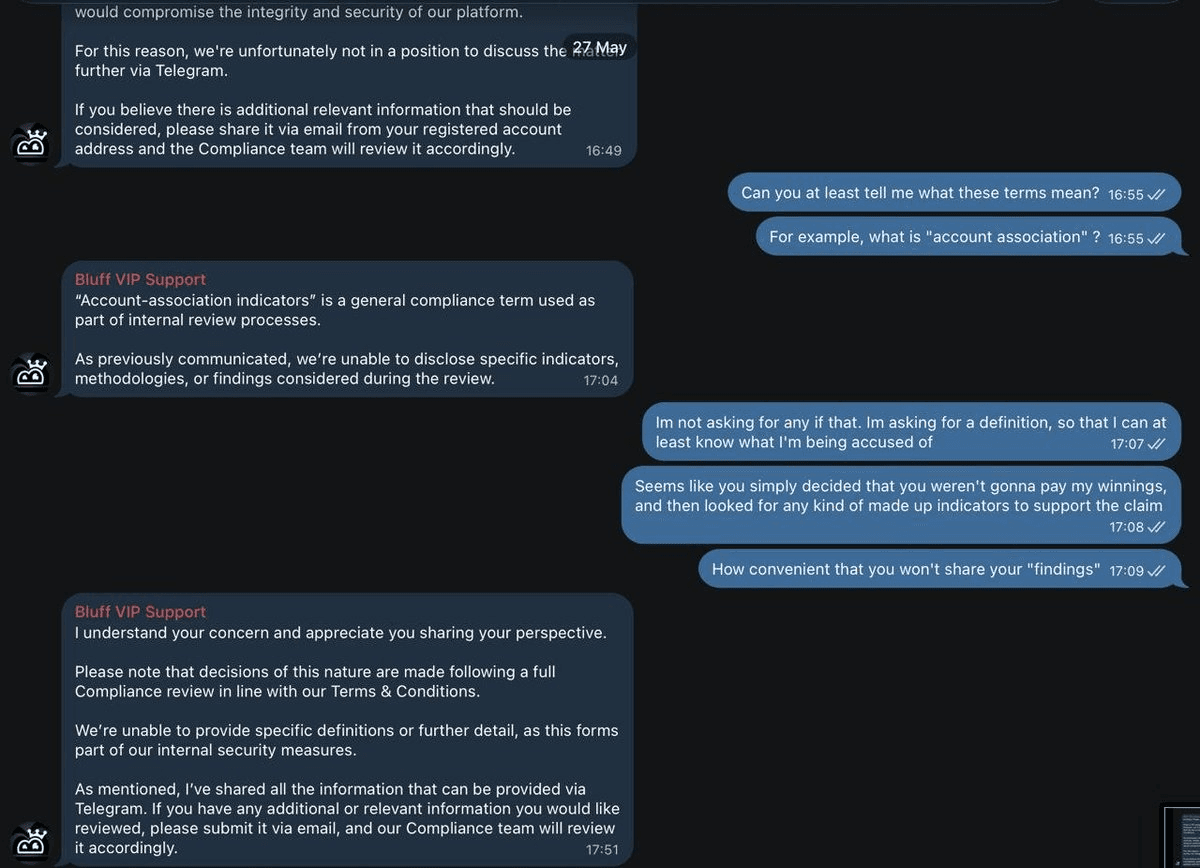
The Bluff dispute does not by itself establish what platform the casino uses or prove that low barriers caused the decision. What it shows is the downstream problem: an operator can accept a six-figure deposit and high-risk play immediately, while the process for reviewing and confiscating winnings can remain largely hidden from the player.
The product was easier to assemble than to operate
Bluff arrived with millions of dollars behind it, but funding can accelerate a launch faster than a team develops the judgment and experience needed to run a casino. Accepting large deposits is easy. Handling KYC, risk reviews and six-figure disputes in a fair and consistent way is the harder part when the team lacks the experience.
Bluff’s sportsbook and prediction-market products rely on outside infrastructure. An inspection of its betting pages shows odds requests being served through sptpub.com with a brand identifier attached to each request. That feed is tied to Betby, a B2B supplier whose products include sportsbooks and fixed-odds prediction markets. Bluff has confirmed that its sports odds come from Betby and other providers, while saying its broader platform and games were built internally.
That is where the low-barrier problem becomes operational. A supplier can provide odds, software and integrations. Investors can provide capital. Neither provides the experience needed to make fair account decisions, explain compliance findings or resolve player disputes consistently. In the Bluff case, the platform was ready to accept a $200,000 deposit and $100,000 wagers immediately. The process used to justify withholding $400,000 was nonexistent.
What a rented casino can hide
Rax, the founder of LIQD, offered Gambling Lore a useful view of the low-barrier problem from both sides. He is building a casino platform, but he also tests newer casinos as a player. That has shown him how little a polished interface reveals about who controls the systems behind it.
Testing newer casinos as a player
At one unnamed casino, Rax says the product looked credible, used recognized game providers and initially processed roughly $100,000 in withdrawals. After another winning run, his account entered review, the explanation changed several times and the previously responsive host stopped replying. He has not named the operator because his concern is the structure behind the brand, not a domain that could disappear or rebrand.
Rax nearly took the same route
That experience took on more weight while LIQD was being built. Rax’s team initially hired an external development provider, nearly relying on the same outsourced route he now warns about. Within weeks, the team found an old technology stack and weaknesses in wallet logic, balance handling and session management. Rather than launch on that foundation, they decided to rewrite almost the entire delivery, delaying the project by months.
Rax had the technical staff and capital to make that choice. Many new operators do not. A white-label or semi-owned setup can provide the platform, wallet, games and even parts of the operations team, allowing a casino to look finished before the company behind it fully understands or controls the systems handling player funds.
The risk behind rented infrastructure
For Rax, the concern is not simply that the software is rented. Operational access may be rented with it.
“In a rented setup, those tools are often shared across multiple brands, handed to rotating contractors, and audited by nobody.”
White-label technology is not inherently unsafe, and owning a full stack does not guarantee fair conduct. Rax’s experience instead points to the central problem: access to a casino platform can arrive before the judgment and operational expertise needed to run it responsibly. He encountered those warning signs and chose to rebuild. Players have little way to know whether another operator saw the same problems and launched anyway.
What Gambling Lore Found From White-label Providers
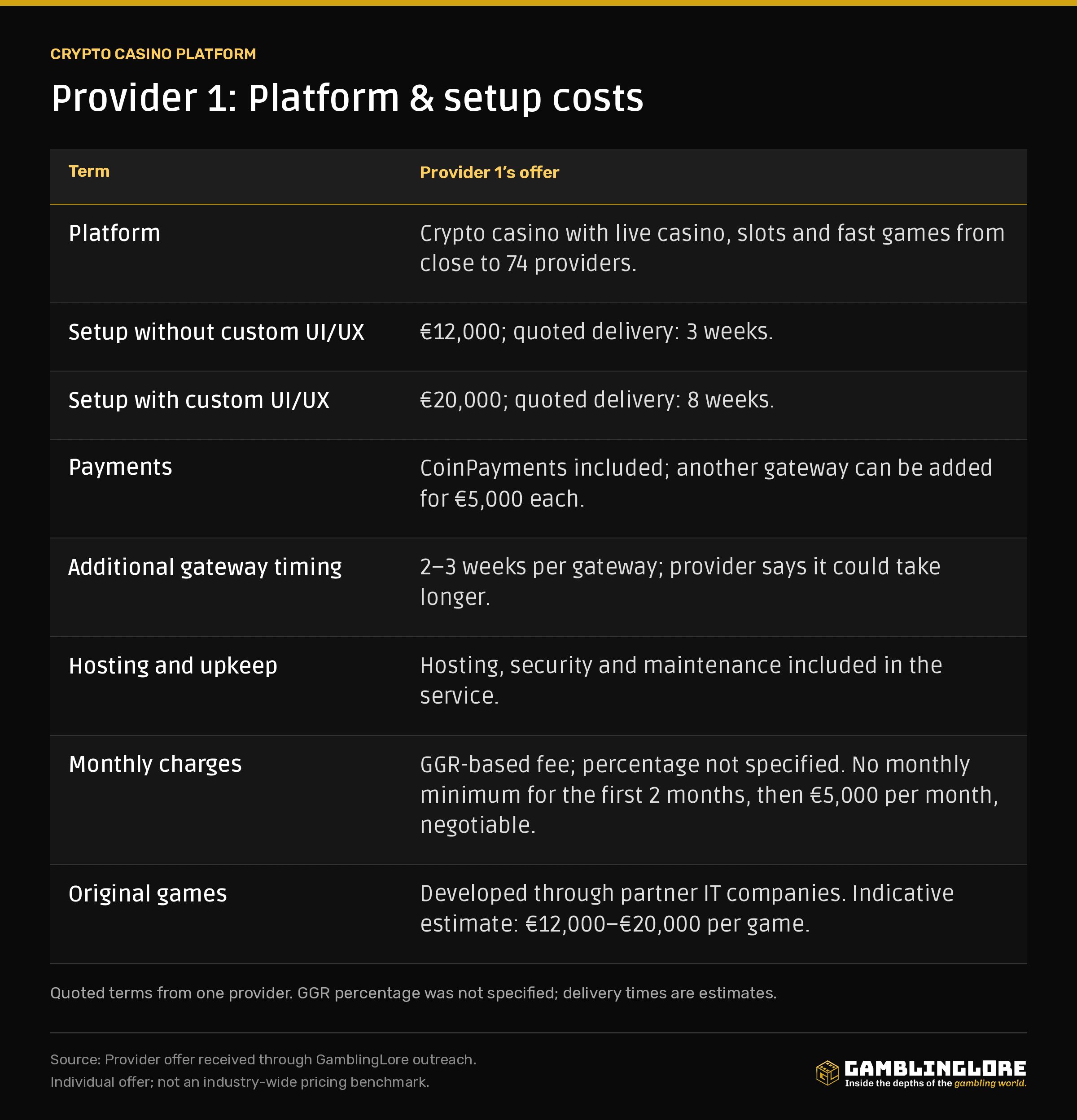
Gambling Lore received offers from two white-label providers through outreach conducted for this article. The terms below show how some providers package the technology and services needed to launch a casino, and how they charge once it is live. These are two individual offers, not an industry-wide price benchmark.
Provider 1: A crypto casino platform with a lower setup fee
The first provider offered a crypto casino platform with optional custom design, payment integrations and ongoing technical upkeep. Original games would be handled by partner developers rather than built directly by the provider.
Provider 2: Packages, add-ons and rising monthly fees
The second provider offered a modular platform with 20 game providers of the buyer’s choice, English-language content creation and population, and bespoke casino design and development. Its Full Pack was described as the package required to start operating, with an Extra Pack adding optional pages and features.
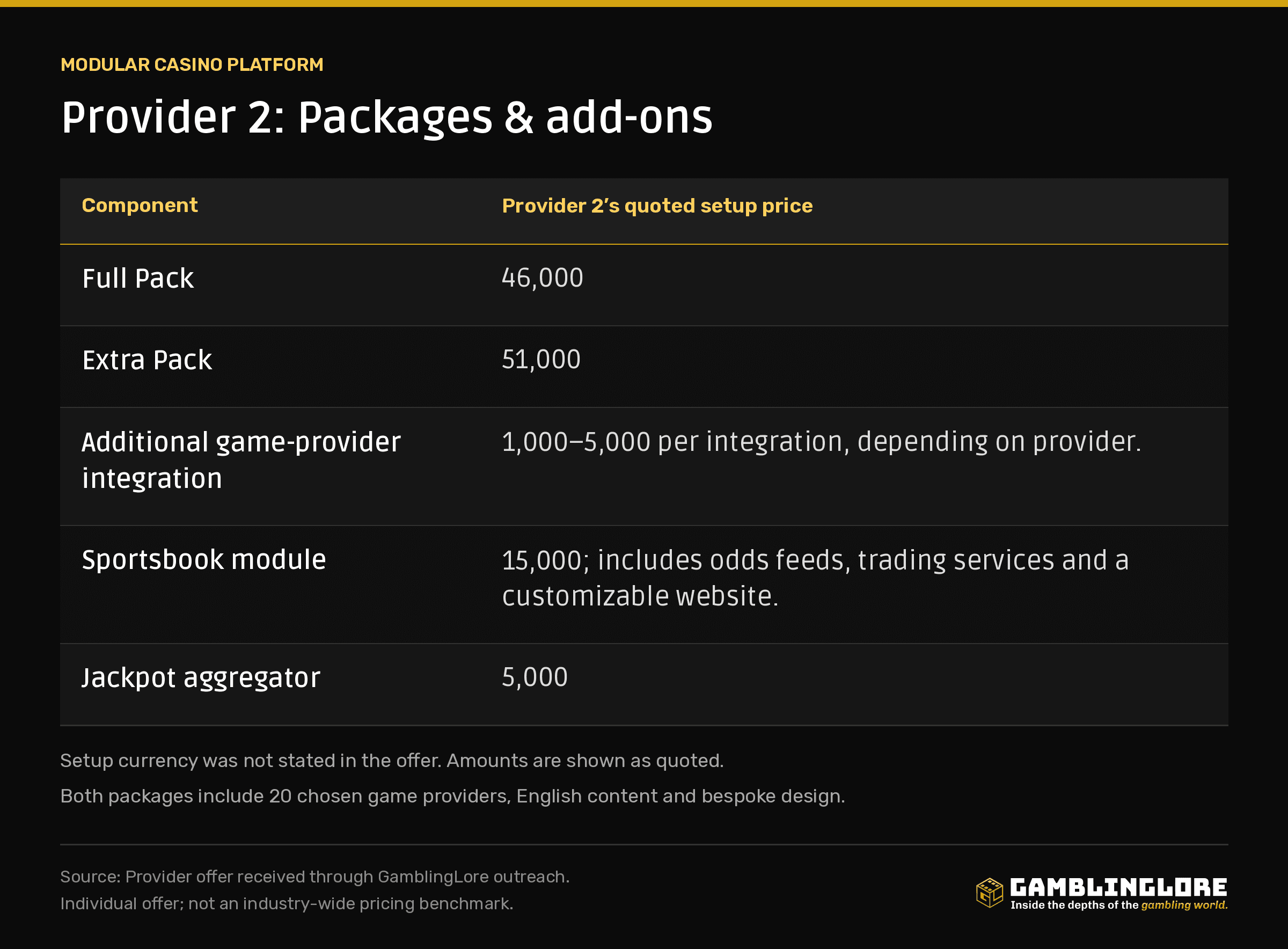
The setup-price did not state a currency. These amounts are reproduced as quoted; the monthly minimums below are explicitly denominated in euros.
The Full Pack covers the home page, promotions, a static VIP page, games lobby and game page, CMS, Customer.io newsletter integration, About Us and support pages, profile and banners, logo and favicon, a progressive web app, a 404 page and an animated preloader. The Extra Pack adds promotion detail, lottery and tournament pages, player landing pages, animated lootboxes, a wheel of fortune and collections. Seasonal calendars, VIP quests, additional animated elements, custom stubs and extra banners are separately priced extras.
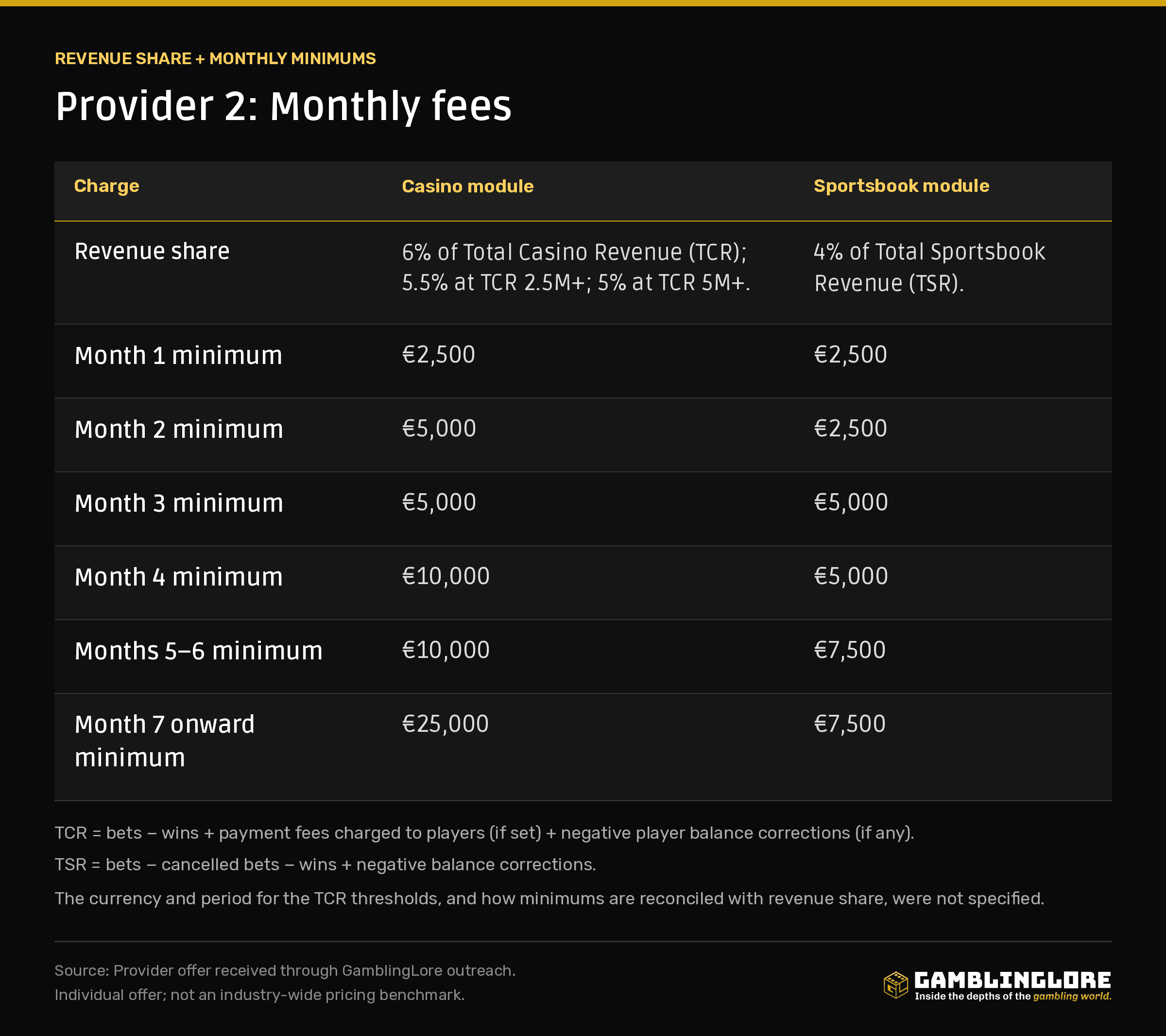
Provider 2’s monthly charges
Alongside setup fees, the second offer quotes a revenue share and minimum monthly fees that rise over time.
What the offers show
The first offer puts a three-week delivery estimate and a €12,000 setup price on a platform without custom UI/UX. The second shows how a launch package can expand through paid modules while recurring minimums increase: its casino minimum reaches €25,000 a month from month seven, with a separate sportsbook minimum of €7,500 from month five.
These are supplier charges, not complete budgets for operating a casino. The material does not establish the total funding needed for player payouts, staffing, marketing or licensing, and it does not show how either provider handles a withdrawal dispute. What it does demonstrate is how much of a casino’s product can be purchased as a package before a new operator has demonstrated the ability to manage player funds responsibly.
The cost of easy entry
The Bluff case and Rax’s account bring the low-barrier problem back to the player. In one, a casino accepted a large deposit and six-figure bets before withholding winnings through a process the player says he could not get a clear explanation of. In the other, successful withdrawals and responsive service gave way to changing explanations and an unresponsive host. Both accounts raise questions about how operators handle player funds once a dispute begins.
The technology needed to launch a casino can now be bought or rented. Capital and marketing can help a new brand attract players before it has demonstrated the experience needed to manage their money. Rax’s decision to rewrite LIQD’s outsourced code shows what closing that gap can require: technical knowledge, additional funding and a willingness to delay launch.
Suppliers can provide software, games and operational support. The operator still has to understand the systems handling player funds, control who can access accounts and take responsibility for withdrawal decisions. Those obligations remain even when another company supplies the technology.
Lower barriers create room for new businesses, but they also allow operators to enter before they are ready. When launching and attracting deposits move faster than operational competence, the consequences fall on the players whose balances and withdrawals depend on it.