InvestigationsCrypto Casinos6 min read
Winna Faces $7.3M Provably Fair Complaint After Failing to Address Technical Evidence
A formal complaint against Winna alleges flaws in the operator's invite-only Slide game undermined its provably fair claims, with the complainant seeking $7.3 million and demanding production of key cryptographic evidence.
 Written by Editorial Desk5 August 2026


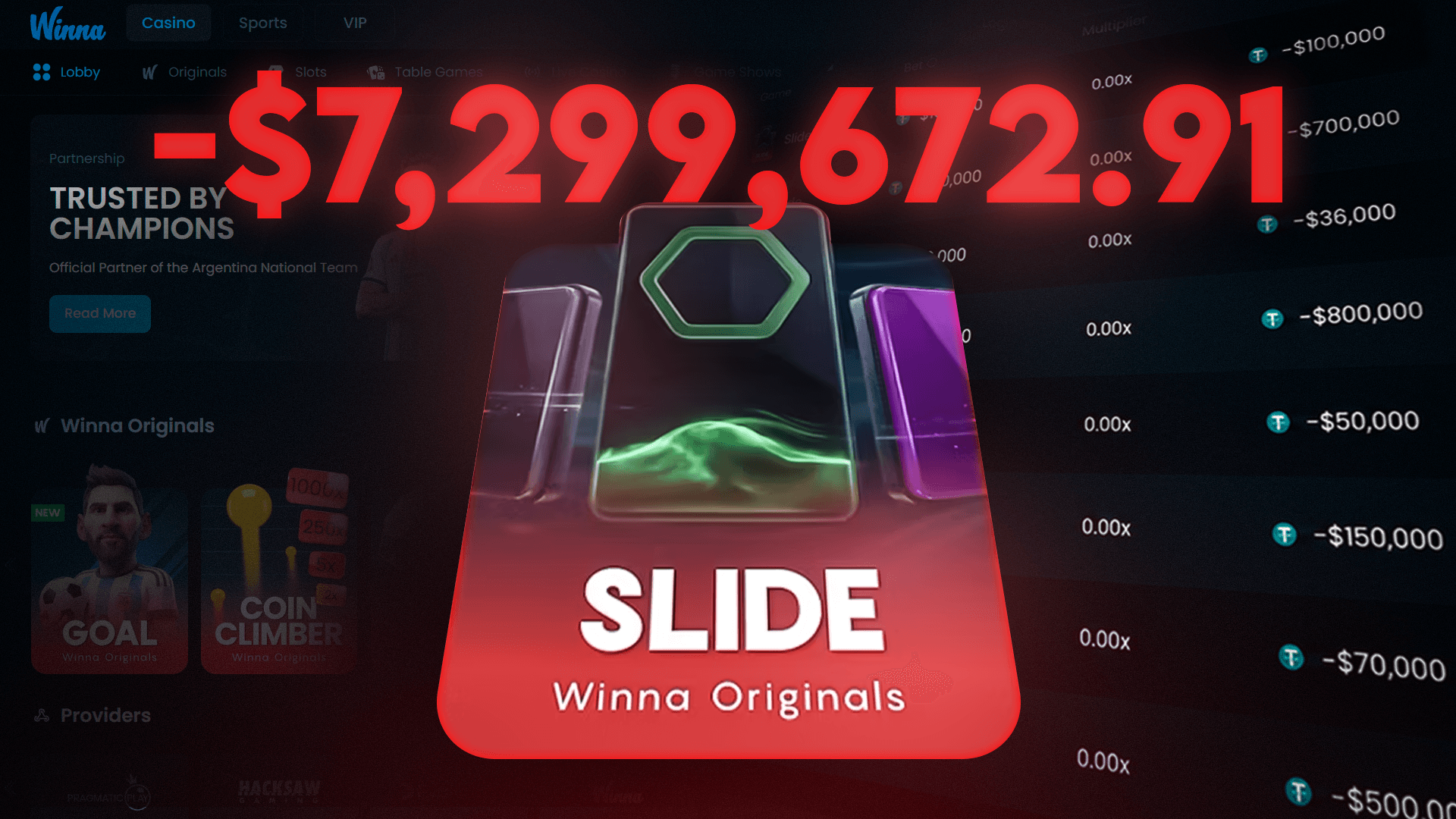
A player is seeking the return of $7.3 million after providing evidence that alleges an invite-only version of Winna's "Slide" game lacked the provably fair protections advertised by the operator. What began as a technical dispute has since escalated into a formal regulatory complaint, with the player providing claims that the operator has yet to address.
The concept of provably fair has long been one of the defining features separating crypto casinos from traditional online gambling. Rather than asking players to trust the operator, these systems are designed to allow every result to be independently verified using publicly auditable cryptographic inputs.
That principle is now at the center of a public dispute involving crypto casino Winna.
A thread published on X by "xxxmourn" provides evidence that an invite-only version of Winna's Slide game (available only to select VIP players at the time) did not meet the requirements necessary to be considered provably fair. According to the evidence provided, the player lost $7,299,672.91 across 62 wagers, winning just one bet, and the player spent weeks attempting to resolve the matter privately with the operator.
After those discussions failed to produce any resolution, the allegations were brought to the court of public opinion.
The Core Allegation
The dispute is not centered on the statistical improbability of losing 61 out of 62 bets.
Instead, the complaint argues that Winna's implementation of its provably fair system allowed outcomes to be determined in a way that was not independently verifiable by players, undermining one of the core principles of provably fair gaming.
According to the investigation, the private VIP version of Slide differed significantly from Winna's public implementation by using:
- A nonce fixed at zero.
- A client seed mined from a publicly known Bitcoin block from 2023.
- Server seeds that were not publicly committed to in advance through a published hash chain.
The player argues that this effectively left the server seed as the only unknown variable. Because the client seed was already publicly known, the operator could theoretically select the outcome associated with any server seed before assigning it to a player.
The complaint does not allege that unfavorable seeds were deliberately selected. Rather, it argues that the system allegedly made such selection technically possible while being undetectable to the player.
Winna’s Internal Messages Raise Further Questions
Among the evidence published are screenshots of conversations allegedly involving Winna team members.
According to the thread and screenshots provided, Winna owner “Paul Winna” acknowledged:
"A 10000% correctly implemented provably fairness verification would always be having the client seed customizable."
When asked whether a fixed client seed meant the operator could theoretically assign an unfavorable seed pair, he allegedly replied:
"Which I guess is true."
The thread also includes messages from another Winna team member stating:
"With a fixed - and not publicly committed - client seed this could have happened."
While these messages do not constitute an admission that manipulation occurred, they have become a central part of the complaintants argument that the implementation itself contained fundamental weaknesses.
Timeline of Events
Beyond the technical implementation, the complaint outlines a sequence of events the player believes is relevant.
Players Timeline of Events:
The player had previously been profitable on Winna's public version of Slide.
Those winnings reportedly ended a third-party bankroll provider arrangement that had been covering Winna's exposure.
The player's limits on the public game were later reduced.
Winna invites the player to their VIP invite-only version of Slide.
The player then lost more than $7.3 million on the private version of the game.
Winna has not publicly commented on these claims. Nor have some of the tagged third-party bodies, e.g. Fairgambling. Who typically remain proactive in the community when covering player reports like this.
Formal Regulatory Complaint Filed
The dispute has since moved beyond social media.
According to information provided directly to Gambling Lore by the complainant, a formal complaint was filed on 22 July with the Tobique Gaming Commission, administered by Differentia Licensing Advisory Group, against licensee GG Gaming S.R.L.
The complaint, filed in the account holder's name with signed authorization, seeks recovery of US$7,299,672.91 relating to the 62 disputed wagers placed on 15 and 16 of May.
Rather than asking regulators to determine whether the game was manipulated, the complaint requests production of specific technical records that could independently verify how the game operated.
Specifically, it asks Winna to produce:
- The pre-bet cryptographic commitments for each of the 62 rounds.
- Server seed generation logs.
- The authoritative round grouping.
- The per-bet target multipliers.
According to the complainant, if those records exist and validate the implementation, the complaint would fail.
Winna’s Legal Counsel Response Focused on Procedure
The operator's deadline to respond was 29 of July.
According to the complainant, Winna's legal counsel responded on the deadline but did not address the requested technical evidence or dispute any of the findings contained in the complaint.
Instead, the response reportedly asked the Commission for procedural guidance regarding whether the complainant's representative was entitled to act on behalf of the account holder, citing that the representative maintains a player account with Winna and is a former affiliate.
The account holder swiftly replied directly to both the Commission and Winna the same day, confirming that he had personally filed the complaint, that its contents were accurate, and requesting that the matter be considered on its technical merits.
According to the complainant, neither the operator nor the Tobique Gaming Commission has responded further since that exchange.
Who Operates Winna?
While the regulatory complaint has been filed against GG Gaming S.R.L, the licensed entity operating under the Tobique Gaming Commission, publicly available information suggests Winna's operations involve multiple companies and individuals beyond the licensed entity.
Publicly available information links Winna to Over99, a Berlin-based iGaming technology company whose employees have openly referenced their work on the platform. One example is Winna's CTO, who is under the handle "OllieWinna" on X while being identified on LinkedIn as Oliver Bannister, CTO of Over99. Together, these public profiles suggest the technology powering Winna is closely tied to Over99.
The company's leadership also appears to be presented differently across platforms. Winna's X account identifies co-founders using the handles "PaulWinnaCom" and "BennettWinna", while LinkedIn instead lists Noah Fischer as an Advisor/Investor and Bennett W. as Co-Founder. Despite Noah's title on LinkedIn, his apparent day-to-day involvement in the company suggests a more active operational role. Taken together, the public profiles indicate that the individual operating under the "PaulWinnaCom" identity is closely associated with Noah Fischer, while "BennettWinna" corresponds to Bennett W.'s public profile.
Noah Fischer has a long history in the crypto gambling industry. Prior to Winna, Fischer was linked to Gambling Apes, an NFT casino project launched in 2022. The project later collapsed after failing to deliver on its roadmap, with investors alleging they lost approximately $15 million.
Blockchain investigator ZachXBT later published an investigation alleging that Gambling Apes was a rug pull. As part of that investigation, ZachXBT identified Noah Fischer's former X account, @be100nf, and linked an Ethereum address attributed to Fischer to on-chain activity associated with the Gambling Apes project, providing additional evidence connecting the identities.
Independent Analysis
The complainant has also published the technical analysis and supporting material in a public GitHub repositories, allowing independent review of the underlying claims.
According to the complainant, ProvablyFair.org separately analyzed Winna's live implementation and reached the same conclusions independently, without input from the complainant.
Verification System No Longer Functions for Disputed Bets
Another issue raised involves Winna's current verification endpoint.
According to the player, Winna’s API returns complete bet information for wagers placed before the disputed session on 14 May, and again for wagers placed from 18 May onward. However 61 of the 62 disputed wagers placed on 15 and 16 of May reportedly return null responses through the same endpoint.
As a result the disputed wagers cannot currently be verified through Winna’s public interface in the same manner as bets placed immediately before and after the session. The complainant argues that the issue is therefore isolated to the disputed betting window rather than being a broad failure of the PF system.
Winna Has Yet to Publicly Address the Technical Allegations
At the time of publication, Winna has not publicly addressed the technical allegations or produced the cryptographic records requested through the regulatory complaint. Those questions now sit alongside broader public scrutiny surrounding the operator, including a growing number of public player disputes and restored Bitcointalk scam accusation threads.
Ultimately, the provably fair complaint can be resolved through evidence: if Winna produces the requested cryptographic commitments, server seed logs and related records, the allegations can be independently verified. If it cannot, questions surrounding one of crypto gambling's core trust mechanisms are likely to remain.