InterviewsOperator18 min read
From RuneScape Kid to Casino Monarch: How Ossi Ketola Built Empire and Returned With Duel
Ossi Ketola went from teenage RuneScape gambling ventures to surviving a Valve crackdown that nearly ended CSGOEmpire. After walking away from the internet, he returned with Duel to challenge the industries product standards with zero-edge games.
 Interviewed and written by supr3me4 September 2026


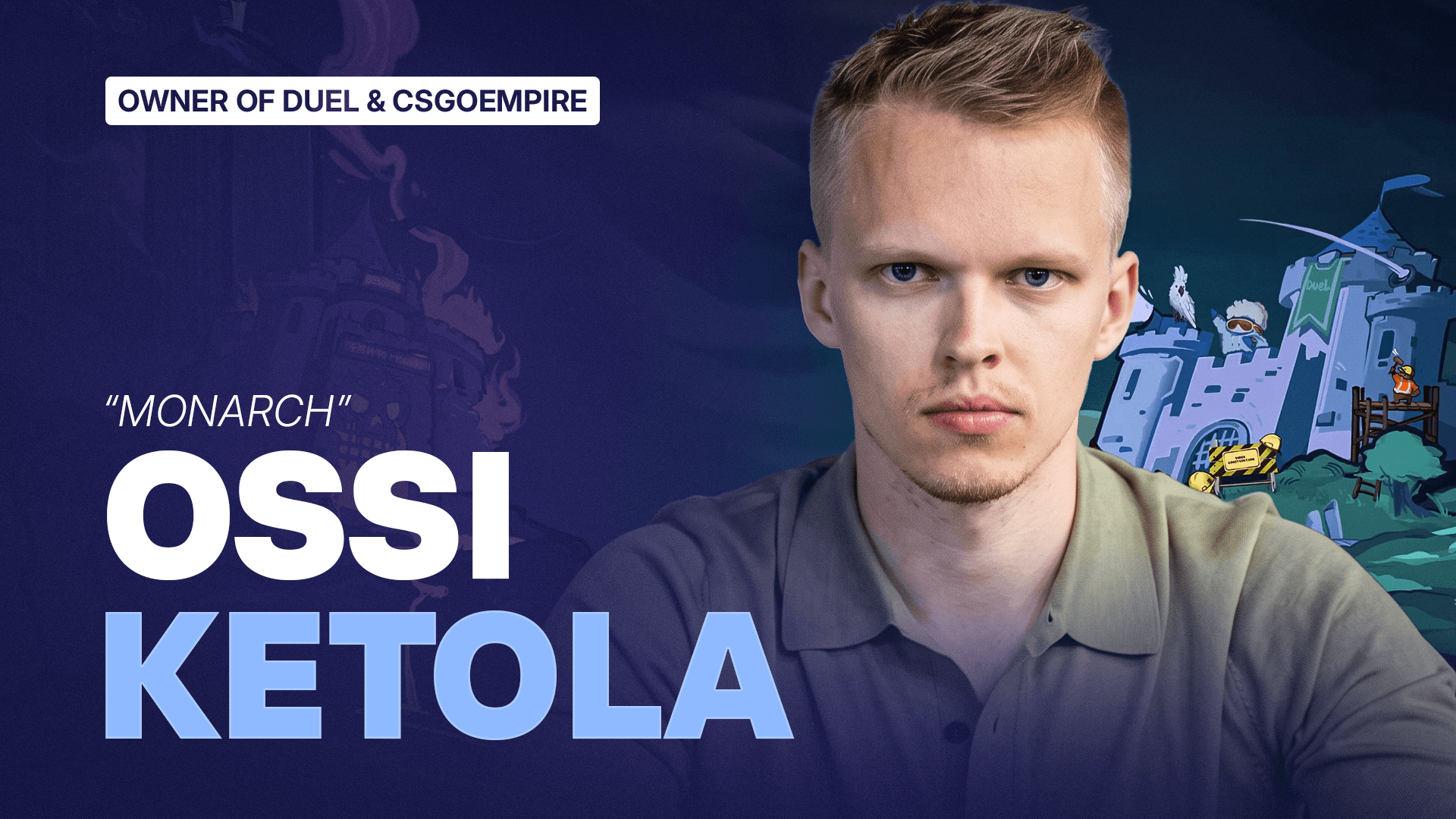
Before Ossi Ketola became Monarch, he was making RuneScape videos and experimenting with the game’s gambling economy.
He started making YouTube videos at around 10 years old and later built an audience through RuneScape content. The game also introduced him to online gambling, player-run markets and competition between operators.
Some of those edges were legitimate.
The money was smaller than the lore suggests. Ketola estimates he made around $25,000 from the RuneScape era and lost a similar amount through high-variance gambling and poor bankroll management. The more valuable return was an education in online markets: how attention moves, how trust is built, how operators compete and how quickly a platform can disappear.
Those lessons led to Big BoiBets, a brutal falling-out with its founder, a two-week attempt to build a competitor from scratch and, eventually, CSGOEmpire. Empire grew from an $11,000 loan into the dominant skin-gambling platform of its era and still to this day. It also came close enough to collapse that Ketola remembers watching his net worth fall from nearly $20 million to $1.9 million while the business burned roughly $600,000 each month.
After surviving, he burned out anyway.
Ketola left the internet for roughly two years, tried to build the life he had skipped while building companies and returned as a louder, more polarizing version of Monarch. Duel is the result of that return: part casino, part product thesis and part status play designed to prove he can build something radically better than the operators he once studied from below.
This is the story of how he got there, in his own words.
The timeline
Early teens
Ketola begins publishing RuneScape videos and experimenting with the Duel Arena, staking and in-game markets.
RuneScape gambling era
He joins BigBoiBets as a minority partner, handling marketing and large amounts of chip trading.
After BigBoiBets
Following a breakdown with founder Killian, Ketola builds RS Gambling in roughly two weeks. The site lasts only days before hosting failures and attacks force it offline.
Counter-Strike gold rush
Ketola borrows $11,000 and launches what becomes CSGOEmpire.
Valve enforcement
As Valve bans casino trading bots, Empire invests heavily in peer-to-peer trading infrastructure and survives while competitors disappear.
Around 2021
After years of growth, Ketola burns out and largely leaves the internet for approximately two years.
Return
A renewed campaign against skin-gambling rivals pulls Ketola back into public view while Duel spends roughly two years in development.
Duel era
Duel launches around a zero-house-edge product and expands toward live games and PVP products.
Before Monarch
Ketola says he started making YouTube videos because he enjoyed making and publishing them.
Ossi Ketola: Everybody wants attention, validation and a way to show off. Making videos was a way of expressing yourself. It was your own form of art.
He believes competition appears naturally when somebody climbs high enough. Other people are already chasing the same scarce attention, money or status. Ketola did not need to love the queue to become fiercely competitive once he entered it.
RuneScape’s Duel Arena turned that instinct into a market. Players arrived with valuable items, negotiated rules and attempted to protect themselves from hidden weapons, disconnected connections and manipulated stakes. Ketola became fascinated by the meta-game around the game: the systems that could be bent, the checks other players forgot to make and the social dynamics other players overlooked.
Ossi Ketola: It was a fascination with how you can hack the reality you are living in, which in that case was the game.
His best-known video showed the oldest RuneScape trick in the book: promise to double a player’s money, pay out small amounts to establish credibility, then disappear when the stake became large enough. The concept was obvious. The performance and scale made it viral.
Ketola continues to frame the video as a parody of the scam itself, but he does not pretend every incident was harmless. He singles out the theft of four blue party hats from a player whose trust he had earned as the worst thing he did during that period.
Ossi Ketola: That was the worst thing I had done. I actually broke somebody’s trust. Everybody makes mistakes, but that one was bad.
The period created a mythology of early wealth that Ketola says is exaggerated. His bankroll rose and collapsed repeatedly because he gambled with small edges and treated temporary success as proof that he could win in every adjacent market. Poker corrected that belief quickly.
Ossi Ketola: I had delusions that I had such an edge in the Duel Arena that I was invincible. Then I went to play poker and got destroyed because it was a different market.
The lesson was early but incomplete: an edge in one system does not automatically transfer to another. Ketola would relearn versions of it throughout his career.
BigBoiBets
BigBoiBets was Ketola’s first experience operating a gambling platform at meaningful scale. Its founder, Killian McKeon-Eccles (who later founded CSGORoll), found him through YouTube and recruited him to handle marketing. Ketola remembers expecting an equal partnership until the terms became a 70/30 split in Killian’s favor.
He accepted. Marketing quickly expanded into the repetitive operational work that kept the market liquid, including hours of trading gambling chips. Killian handled servers and the back end. Ketola supplied attention, labor and a public identity that could pull RuneScape users into the product.
Ossi Ketola: He recognized something in me and thought he should use me for marketing. It was a brilliant hire. It was also the worst firing of his life.
The partnership lasted roughly nine months. Ketola says the environment became increasingly hostile as Killian pressured him to attack competitors. He describes participating in some of that warfare and resisting other targets he considered undeserving.
The same period introduced him to medication he would later connect to his working habits. Ketola says Killian encouraged him to take modafinil while he was still a minor, to help him perform better. He says the experience led him to research ADHD, visit a doctor and receive a prescription for ADHD medication that he took for roughly seven years.
Ketola is critical of his years on ADHD medication, but he does not present Killian’s decision to give him modafinil as the sole cause of his eventual burnout. He calls it a “butterfly effect,” one early event in a much longer chain. In his account, burnout followed years of medication, extreme work and neglecting every other part of his life.
His comments about medication reflect his own experience and beliefs, not a medical assessment of ADHD or its treatment.
The relationship finally deteriorated around workload, control and a proposed buyout Ketola believed would ignore the platform’s growth. Before a price was agreed, he moved to build his own competitor.
Two weeks to build a casino
RuneScape Gambling was Ketola’s first attempt to own the full stack. He had marketed a gambling site and traded its chips. He had not built its website, managed its servers or carried sole responsibility for player balances.
He gave himself little time to learn.
Ossi Ketola: It was absolute hell. In roughly one or two weeks, I learned how to build a platform, built it from scratch and launched it.
The interface was assembled in Microsoft Paint. The website contained little more than a header, a footer and a connection to third-party poker software. Ketola followed an Uberman sleep schedule, taking approximately 15 minutes of sleep every three hours while trying to keep the site alive.
It did not last. Ketola says attacks and pressure culminated in his hosting provider shutting down the server, creating data loss and an operational mess he was too sleep-deprived to repair.
Ossi Ketola: I told the public, “I’m done. I will handle the financial mess and pay the debts after I’ve slept.” Then I slept for more than 20 hours, came back, refunded people and disappeared.
He had already dropped out of school.
With the company gone, Ketola played League of Legends and studied the skills he thought a future online operator might need: web development, data analysis, marketing and basic security. As a practice project, he built a crude crypto-casino prototype that never launched.
His parents had questioned his decision to leave school. He had shown that he could make money online, but they did not know where it would lead. They let him pursue it while remaining concerned.
Then Counter-Strike skins created the opportunity he had been preparing for without knowing its name.
The Counter-Strike gold rush
Ketola was not a committed Counter-Strike player. He entered because he heard people were making serious money from gambling with skins and recognized a market that looked irrationally open.
Ossi Ketola: There was a gold rush, and I happened to be pretty good at mining that kind of gold. So I went all in.
CSGOEmpire began with an approximately $11,000 loan, giveaways and creator partnerships. The obvious marketing battlefield was English-language YouTube, but established creators were expensive. Ketola recalls paying around $100,000 for some early videos from Anomaly while creators of a similar scale in Portuguese-speaking markets could cost closer to $10,000.
That price gap became an acquisition advantage. Empire spread through Portugal and Brazil while competitors concentrated on the saturated English market. Ketola says the opportunity was not a grand strategy at first; one affordable partnership led to referrals, which led to a cluster of creators, which created momentum.
Empire also gained a co-founder through League of Legends. Thomas supplied the outgoing, socially fluent skills Ketola felt he lacked as an introverted internet operator. Years later, after Ketola had learned those functions himself, he bought Thomas out through a complex installment arrangement that Ketola described as a substantial seven-figure or low eight-figure deal.
No single partnership or geographic market explains Empire’s growth. Ketola’s own answer is less tidy.
Ossi Ketola: There is no single “aha.” I worked my ass off for it. It was blood, sweat and tears, and I was very good at the game. I was playing at a higher elo than the people around me.
The company was profitable from its early days and, according to Ketola, roughly doubled year after year. That record can make Empire appear inevitable in retrospect. It was not.
Three months from the edge
Valve’s cease-and-desist letters shook weaker operators out of the market, but Ketola considers them less important than Valve’s decision to enforce its policy by banning the trading bots that gambling sites relied on. The threat attacked the infrastructure of the category, not only its legal confidence.
At the same time, a crypto crash crushed the value of Ketola’s holdings. He remembers a moment when a net worth near $20 million fell to approximately $1.9 million while Empire carried roughly $600,000 in monthly expenses.
Ossi Ketola: I had about three months left. When a situation is dangerous enough, if you stop to think about death, you die. It becomes a “Jesus, take the wheel” situation and you just try to survive.
Much of the burn was deliberate. Empire was building a peer-to-peer trading system that could remove its dependence on the centralized bot inventories Valve was banning. Ketola says the company continued processing volume through “kamikaze bots,” knowing individual accounts would eventually be lost, while the replacement system was completed.
The bet worked. Empire survived, introduced peer-to-peer trading and held what Ketola describes as a tight market grip for roughly two to three years. The survival story also established a pattern that runs through his account of every business: move early, accept extreme short-term pressure and assume the organization will find a way to remain alive before the clock expires.
Ketola calls Empire an immortal cockroach. It was not invulnerable. It was difficult to kill.
How Monarch became Monarch
The name began as a Skype username. Ketola asked Thomas what he should call himself. Thomas looked at the company’s name and answered with a question: who runs an empire? A monarch.
For a time, it was only an alias. Ketola says the character became real when he used an employee’s account to publish claims that CSGOWild had rigged games. When the target fought back, the volume and stakes of the argument grew until he decided to abandon the proxy and speak under his own name.
Ossi Ketola: I said, “I need to go into the trenches myself.” That is when Monarch came out. That is when I became Monarch.
The campaign became a sequence of public confrontations with skin-gambling sites. Ketola targeted rival operators over alleged rigging and unethical conduct, and Empire absorbed the reputational benefit. Players no longer saw only a logo and a roulette wheel. They saw a person willing to fight in public and attach his reputation to the claim that his platform could be trusted.
Ketola believes this visibility became central to Empire’s brand. He was young and physically unknown to much of the audience, but his restrained writing style created the impression of an older executive.
Ossi Ketola: People were shocked when they met me in real life and saw a little kid. They thought I was a 40-year-old businessman. Back then I was stable, contained and suited up, like somebody running for president.
The modern Monarch is less contained. Ketola describes the change as moving from a presidential persona to a deliberately polarizing one. The underlying function remains similar: convert personal conflict, performance and spectacle into attention a casino brand would struggle to earn on its own.
The cost of winning early
By the time Empire controlled its niche, Ketola had money, proof of competence and little desire to keep grinding the same machine. He estimates that he once held close to $100 million and believed he could build a general crypto casino capable of competing with Stake. He chose not to pursue it because the expected lifestyle seemed worse than the marginal wealth was worth.
Around 2021, years of intense work and long-term stimulant use caught up with him. Ketola says he had neglected nearly every part of life outside the business. He says he largely left the internet for about two years. Empire remained with the people already running it, whom he likened to “weird uncles” who kept the company alive, even if some things would have been better left undone.
Ossi Ketola: I had made a bunch of money, but what else did I have? Nothing else. What are you going to do with the money, and what are you going to do with your life?
The hiatus reversed the usual order of adult development. Ketola had pursued a career during the years when most teenagers learn how to make friends, date, fail socially and construct an identity outside work. With the company already built, he tried to catch up.
He remembers having only a few friends and not knowing whether the relationships around him were the right ones. He could be surrounded by people and still feel lonely. He describes having friends on paper without feeling comfortable or fulfilled in those relationships. Repeatedly, he changed his social circle and tried again.
Ossi Ketola: It was quite very lonely, even though you were kind of surrounded by people.
The frustration was not simply that he had missed out on parties. He had made enough money to stop working, but did not know how to build a satisfying life outside it. He remembers trying different things, finding them unfulfilling and wondering whether something was wrong with him.
He traveled, went skydiving, hiked in the Himalayas and spent time with a remote tribe. He experimented heavily with drugs and describes a period when substances appeared to solve the social limitations created by years of isolation. They also damaged the judgment required to recognize their own cost.
Some of the travel was enjoyable, but it did not solve that problem. He found skydiving boring. Hiking in the Himalayas and hunting in the jungle offered moments he enjoyed, rather than the lasting change he had hoped to find.
MDMA was one of the drugs he discusses directly. He remembers struggling to talk to women and feeling uncomfortable in social situations. Taking it made those interactions feel easier. For someone who had spent much of his life online, that was a powerful attraction.
Ossi Ketola: One of the first and one of the biggest excuses was that it was like a big social lubricant.
That apparent benefit is also what he now describes as the trap. Feeling more comfortable made it easier to underestimate the harm and keep experimenting. He says the drugs affected his judgment, including his ability to recognize when his own use was becoming a problem.
Ketola says he went deeply into some of that experimentation and considers himself fortunate to have come through it. He talks about the importance of having people around who can recognize when things are going wrong. His account is not that the risks were imaginary, but that he understood them much less clearly at the time.
The phase did not end on a single day. Ketola does not claim to have stopped partying altogether; he says it simply became less frequent as he grew bored, tired of the hangovers and felt he had learned what he could from that phase.
More recently, Ketola has turned more attention to his health. He describes severe neck and hand pain, becoming interested in water fasting and adopting a mostly vegetarian diet. He believes the dietary change reduced his pain, though that is his personal account rather than evidence that the same approach would treat someone else.
This was not a clean recovery narrative or a retreat from ambition. The change was gradual: less partying, more attention to his health and, eventually, a return to work on different terms.
Ossi Ketola: I lived my life in a different order. Most people go through the social phases in school and then pursue a career in their twenties. I did it the other way around.
He now says he feels more fulfilled by the people around him, creative work and running Duel. Finding that combination took repeated attempts to work out what suited him, rather than one experience that changed everything.
His way of working has changed too. As a teenager, he could spend his days at a computer handling technical tasks himself. He now delegates more and concentrates on the projects and creative decisions he enjoys. A larger business no longer means, to him, returning to the same life that burned him out.
The return
Ketola says seeing Killian and other familiar operators “hardcore scamming” pulled him back into the industry. What began as another effort to clean up the space expanded into public confrontations, stunts and events while Duel was still being built.
One of those experiments was the “cult” built around the Monarch persona. Ketola says the goal was to create something legendary, but the campaign became too esoteric: its dense lore resonated with a small group without giving him much evidence that it worked as marketing. The experience taught him to favor ideas that are easier to understand, test and measure.
Ossi Ketola: What is the benefit if only 20 people truly understand it? We made things too esoteric. People do not have the attention span. I learned to make decisions based on what actually works.
Duel had existed as an idea for years: a casino where players could compete at or near zero house edge. Ketola investigated it more than once and concluded the product was too difficult to execute. Eventually the idea became non-negotiable. He committed the team to roughly two years of development, including long stretches when the path to a viable launch looked uncertain.
Poker supplied the simplified spectacle his earlier campaigns lacked. Ketola’s first appearance at Triton was not planned as a marketing event, but a deep tournament run put him in front of a new audience. After Duel launched, high-stakes heads-up matches became a deliberate and expensive acquisition strategy.
Losing roughly $20 million in a night delivered a message far more quickly than a complicated manifesto could. The loss hurt. That was part of the point.
Ossi Ketola: It is like entering a boxing ring and getting punched in the face. Nobody pretends it does not hurt. But being willing to go into the ring and take the punches deserves some credit.
The zero-house-edge wager
Duel’s central proposition sounds hostile to the business model of a casino. If the house gives up its mathematical advantage, what remains to monetize? Ketola’s answer is that the superior product becomes the acquisition engine for a broader gambling platform. Players arrive for better odds and continue using products where the economics differ, including third-party slots and other verticals.
That interpretation is supported by Ketola’s description of Duel’s performance. He says the company became profitable faster than expected and that slot play was materially stronger than he anticipated. In this model, zero-edge games can create value beyond any revenue they generate directly by attracting players who keep balances on Duel and use its other products.
Ossi Ketola: I wanted to build something radically better. That does not mean I do not care about money. I want to make profit. I believed I could build the superior product and eventually make a lot of money with it.
The idea is also a competitive weapon. Traditional operators must decide whether to match Duel’s economics and compress margins, dismiss the proposition and risk appearing expensive, or imitate only narrow parts of it. Ketola argues that several responses have been deliberately constrained or marketed more aggressively than their practical benefit justifies.
His own claim should still be examined game by game. Some Duel products have returned the final fraction of RTP through instant rewards rather than only through the base game, a distinction Ketola calls technical rather than economic.
What matters strategically is not whether every customer understands the mechanism. Duel has established ownership of the low-edge narrative strongly enough that rival products are now interpreted in relation to it.
A market of “mere mortals”
Ketola entered the Duel era expecting stronger resistance. Instead, he says the launch reinforced a belief that had developed slowly since his first Counter-Strike business: markets that look mature from the outside are often controlled by people improvising behind impressive numbers and brands.
Ossi Ketola: People think the competition at the top must be perfect. The little secret is that they are mere mortals. Nobody really knows what is going on, and there is plenty of loose money and opportunity in the marketplace.
His language about competitors is deliberately dismissive, but the underlying observation is more useful than the insult. Incumbents can be operationally large without being strategically fast. Their scale becomes an advantage in distribution and a constraint when a challenger introduces a model that threatens the margins their business was built on.
Ketola believes Duel can become a strong number two and considers that outcome acceptable, even while leaving open the possibility of eventually taking the top position from Stake.
The ambition is no longer hidden behind modest language. That is part of the modern Monarch product as well.
Building Duel brick by brick
For all Ketola’s confidence, Duel remains unfinished. He describes the current product as genetically strong but held together by duct tape in places. Sound effects arrived only shortly before the interview. The sportsbook relies on third-party infrastructure with limits Ketola considers inadequate.
The roadmap is broad: an in-house sportsbook, a lower-fee or zero-fee prediction market, more branded live games, a Duel Arena containing potentially hundreds of PVP games and expanded live casino formats. Ketola mentioned poker, blackjack, baccarat and a proprietary answer to Crazy Time as active areas of interest.
Ossi Ketola: Duel has great genetics, but it is still 12 years old and has barely hit puberty. There is a long way to go.
The metaphor captures the tension in his current position. Duel is mature enough to validate the central thesis and young enough that nearly every system can still change. Ketola’s task is no longer proving that an online casino can launch with a radically lower edge. It is proving that the proposition can survive scale, third-party dependencies and the operational complexity of becoming a full scale gambling platform.
He says the company is not falling behind. The remaining gaps are construction work, not evidence the foundation failed.
Ossi Ketola: Rome cannot be built in a day. I am focused on building brick by brick. In not much time, we already have something outstanding.
From hacking the game to rewriting it
Ketola’s career can be read as a series of increasingly large attempts to change the rules of the system he entered.
In RuneScape, that meant exploiting the social rules around the Duel Arena. At BigBoiBets, it meant turning a YouTube audience into gambling liquidity. In RSGambling, it meant trying to replace an abusive partner in two weeks and discovering how fragile ownership becomes when the infrastructure belongs to somebody else. At Empire, it meant surviving Valve by rebuilding the way skins moved between players. With Monarch, it meant turning public accountability into a brand asset. With Duel, it means challenging the assumption that the casino’s edge must be visible in the games that acquire the customer.
Not every attempt was defensible. Some harmed people. Some failed. Some produced a persona that now invites as much hostility as admiration. Ketola’s own story is strongest when it does not flatten those contradictions into a founder myth.
The operator who built a reputation by attacking unethical rivals admits participating in early competitive warfare. The gambler who can lose eight figures as spectacle is building a platform around the claim that players should lose less to the house.
Ketola repeatedly entered games whose rules were written by somebody else, found the leverage hidden underneath them and acted before the rest of the market agreed the move was rational. Duel is the largest version of that bet so far.
Continue reading
- Related analysis:Duel Analysis: From CSGOEmpire’s Foundation to a Zero-Edge Casino