InsightsIndustry & Trends6 min read
The Casino Table Is Becoming the Show
Duel’s live blackjack, Gambling Circus’s bespoke tables and Pragmatic Play’s Kevin Hart event point to a growing overlap between casino games and live entertainment.
 Written by blinded3 September 2026
Listen to this article
AI narration · 11 min


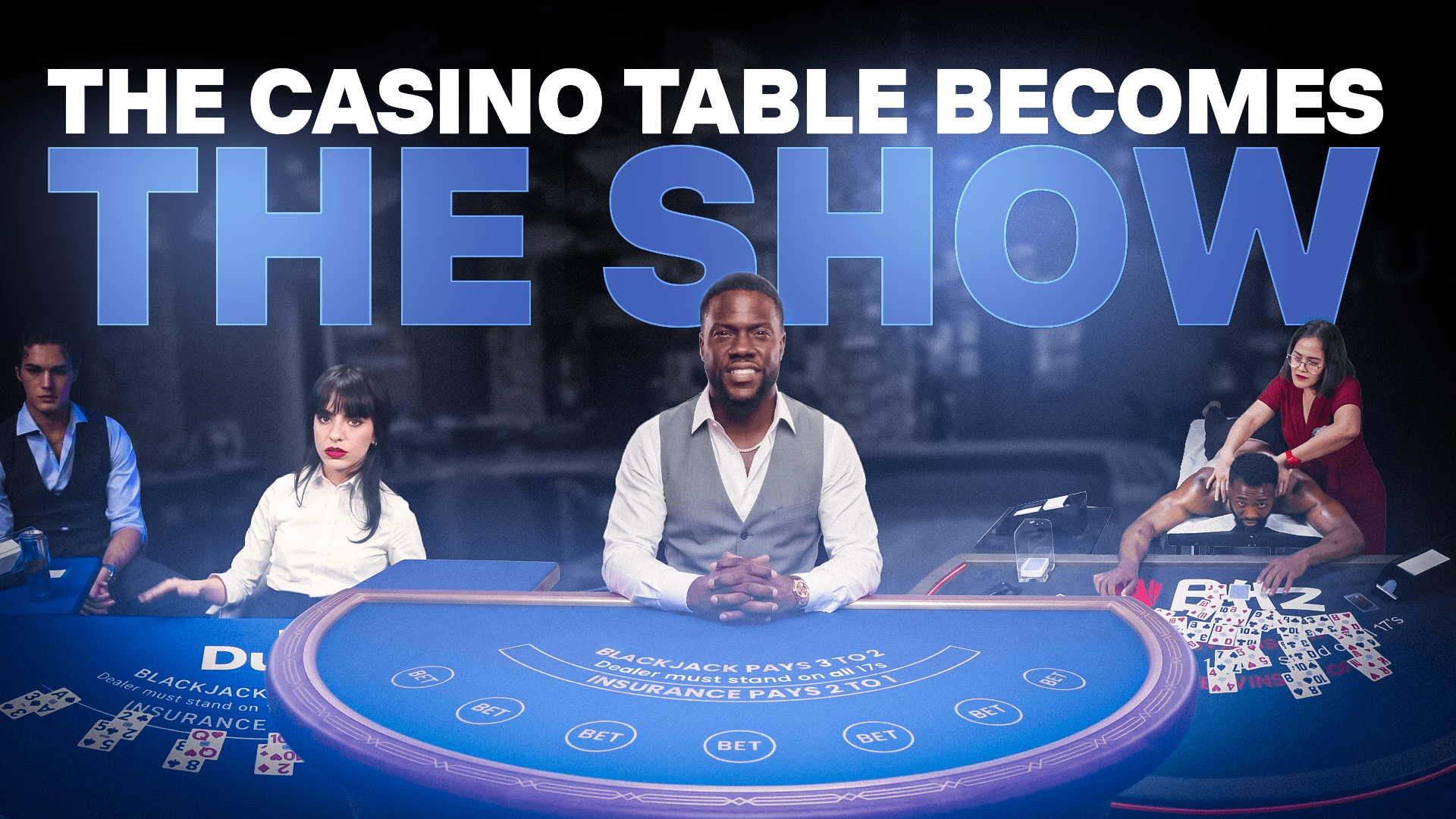
Kevin Hart is heading into a live casino studio. Duel is circulating blackjack clips built around internet characters and controversial table moments. At Bitz.io, Gambling Circus is behind a new live blackjack production providing the creative direction and a dedicated clipping platform. Across these examples, the people around the table are becoming as much a part of the attraction as the game.
Pragmatic Play’s Kevin Hart announcement gives the trend a mainstream celebrity face. Duel shows how an operator can build an identity around its own table production, while the company behind the recent live table launch at bitz.io, Gambling Circus is offering to create and distribute bespoke live game experiences for other casinos. Together they suggest a broader commercial opportunity: turning live play into entertainment that also brings eyes to the product.
The Entertainment Moves Inside the Casino
Gambling content often centres on someone playing a game: a streamer reacts to a hand, a win or a loss, and the audience follows their session. A personality-led live table moves part of that performance into the game itself. The dealer, guest or recurring character becomes someone players recognise, and the table becomes a setting for content.
That creates two audiences for the same broadcast. Players experience it inside the casino, while people scrolling social feeds encounter short moments from it. Someone can enjoy a joke or a confrontation without understanding the preceding hands. If the room has a recognisable identity, that attention can point back to a specific operator.
The opportunity is more specific than putting a logo on a familiar game. It is giving people a reason to choose this table, with these personalities, over another version of blackjack elsewhere. The entertainment becomes part of what the casino offers.
Duel’s Table Becomes Part of Its Identity
Duel provides an example of that approach through its own live blackjack production. The Eagle clip shared with this article is promoted with the “freakbob” tag and an invitation to check it out on Duel. Other posts from the same account promote guest appearances, including Mia Malkova at the table. The promotional hook is who is there and what happens around them, alongside the cards being dealt.
The format gives the casino material that can travel beyond the players present during a session. A recurring personality can become familiar through clips before a viewer ever opens the site. For an operator, that offers a way to build recognition around a product experience of its own.
There is also a distinction between having someone appear once and building a show people follow. Recurring performers, table interactions and an identifiable tone can give the room an identity.
What Duel’s Reported Growth Shows
In a May post, Korra, whose X profile identifies a role at Duel, attributed increases in several activity measures to Duel Blackjack. The post reported the following before-and-after figures:
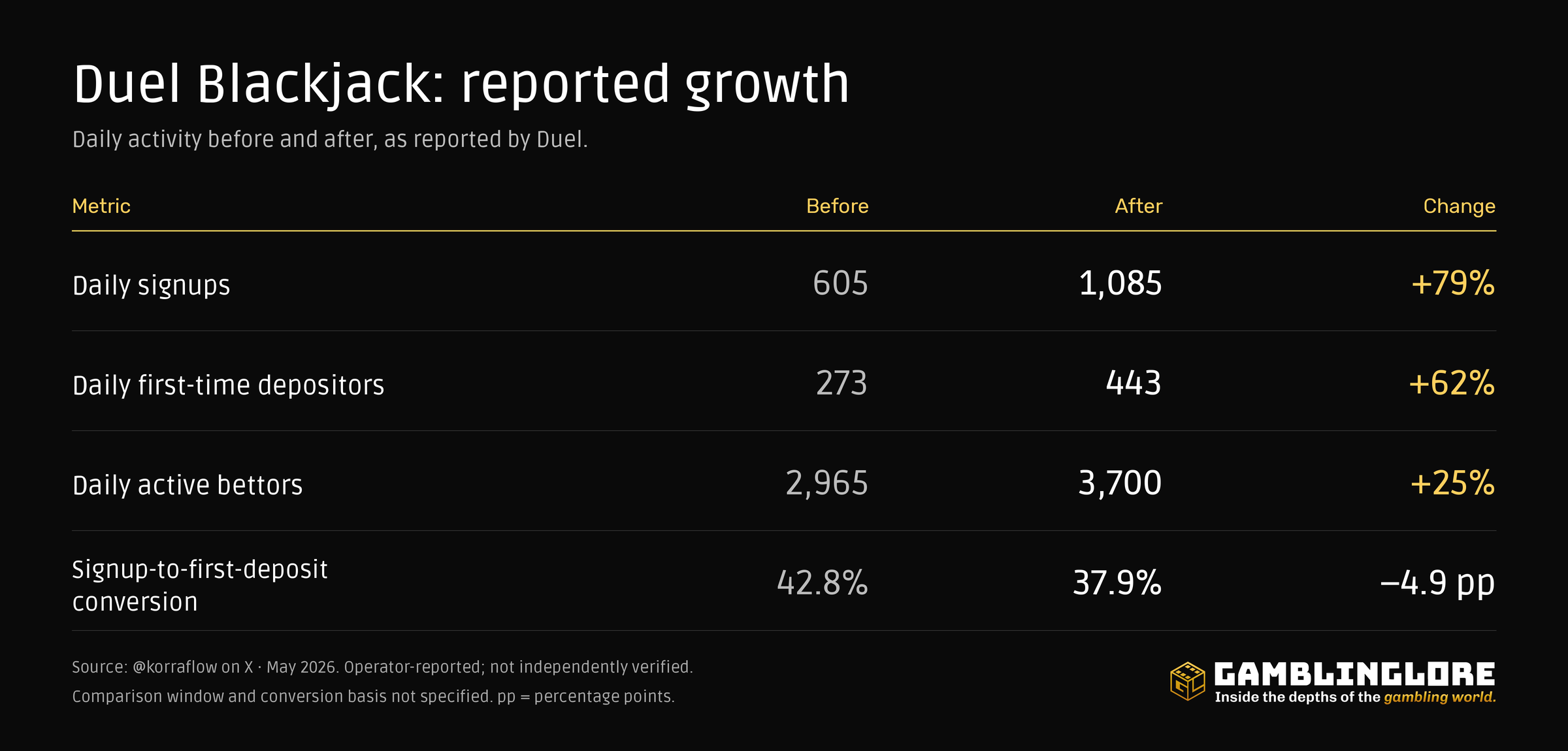
The post also reported weaker signup-to-first-deposit conversion. More new depositors alongside a lower conversion rate suggests a larger audience arriving, with a smaller share taking that next step.
Gambling Circus Wants to Take the Format to More Operators
Gambling Circus is looking to turn bespoke live entertainment into a service other operators can buy. Its published offer covers custom rooms and tables, camera-trained dealers, content schedules, guest appearances and ongoing creative changes. It also includes clipping and distribution, putting production and promotion within the same service.
Gambling Circus co-founder “ventful” described the gap in feedback for this article: “You've got development and marketing teams with no experience in IRL production”.
Building and marketing an online casino is a different job from running a physical live production. A casino may have developers, affiliates and a marketing team without anyone experienced in casting, managing a crew, coordinating guests or directing a live show. Doing it in-house means building that capability and keeping it running, not simply adding another game.
Using a traditional supplier does not necessarily solve that problem on terms the operator wants. According to the Gambling Circus team, traditional providers often want full control over the set. That leaves less creative control for an operator to shape the room around its own branding, audience and ideas, which is the point of commissioning a bespoke experience.
The team also argues that the share of gross gaming revenue (GGR) some suppliers demand is too high to make sense for high-volume operators. The concern is how that cost grows: as a table generates more GGR, the provider’s percentage produces a larger bill. An operator bringing substantial player activity may question how much of that revenue it should give up for the production service.
The team also points to licensing for the physical live operation as another obstacle to building in-house. In their account, the barriers are not just finding a room and putting a dealer in front of a camera. Operators would face the logistics of licensing obstacles, production management, and distribution logistics.
That is the gap Gambling Circus is positioning itself to fill. Its offer brings the production team, creative direction, guest management and distribution together around the operator’s brand. A casino can choose to build those capabilities itself, but buying the service means it does not have to assemble and manage a separate live-entertainment operation from scratch.
The company says it can launch a table in five to six weeks when assets and approvals are ready, with custom formats requiring additional design and rehearsal. Its proposition is to curate a show around each operator’s brand and audience, then keep developing it after launch.
Bitz.io provides a concrete example. Its live blackjack clipping site credits Gambling Circus as the production company, lets users rewind through 48 hours of footage and make clips, and advertises payment for posting. A Bitz Clipz post promotes one table moment through a dramatic dealer-reaction headline.
The clipping side matters because distribution is built into the operation and what makes this growth engine work for operators. A live broadcast produces far more footage than most people will watch. Making it easy to find, cut and post moments gives the show a route into feeds outside the casino. The clip can introduce the room; the room supplies the next clip.
The out-of-the-box value is more than getting a table live quickly. Gambling Circus handles the logistics, guest management and heavy creative work needed to keep the show running, alongside promotion and distribution. But a supplier still has to make each room distinctive. If every casino ends up with the same jokes and interchangeable personalities, the reason to seek out a particular table becomes weaker.
Kevin Hart Brings the Celebrity Event Model
Pragmatic Play’s announcement takes the concept in a different direction. Hart is scheduled to host four sessions across Nov 6, 2026 and Nov 7, 2026, with the exact games revealed on each day. This is an announced guest-hosting event on existing live casino titles; the announcement does not describe a permanent Kevin Hart table.
The campaign includes planned free-chip promotions before the broadcasts and random cash prizes during Hart’s sessions. Pragmatic Play says the event will not be available in the UK, with other jurisdictional restrictions possible.
Hart brings an audience that already knows him. That creates the possibility of an appointment event: players turn up at a particular time because a particular person is hosting. The commercial question comes afterwards, when the celebrity leaves and the operator has to give those visitors a reason to return.
This also differs from an operator’s exclusive room. A supplier-led event can benefit participating operator partners, but the celebrity association may attach most strongly to the supplier or game. An operator-owned format has a more direct opportunity to make the entertainment part of its own identity.
From a Viral Moment to a Reason to Return
These examples show three ways to pursue the same opportunity: build an ongoing show around an operator’s table, buy a bespoke production and distribution service, or bring a celebrity into scheduled live sessions. Their costs, reach and ownership differ, but each gives the audience something to follow beyond the outcome of a bet.
Duel’s reported figures offer an early commercial signal. Gambling Circus is trying to make production and distribution repeatable for more operators. Pragmatic Play is testing what a globally recognisable host can bring to a live casino event. None of those examples, on its own, settles whether the attention produces lasting value.
That will depend on what happens after the clip or appearance: whether visitors become players, whether they return, and whether the value of that activity covers the cost of the show. For live casino, the emerging competition is over who can create a table people remember and choose to come back to.