InsightsCreators & Affiliates7 min read
The Streamer Economy: Casinos Bid Millions to Rent a Player Base
From Stake and Roobet’s early streaming push to Mitch Jones latest Rainbet deal, casinos are spending millions to turn viewers into regular players.
 Written by blinded2 September 2026


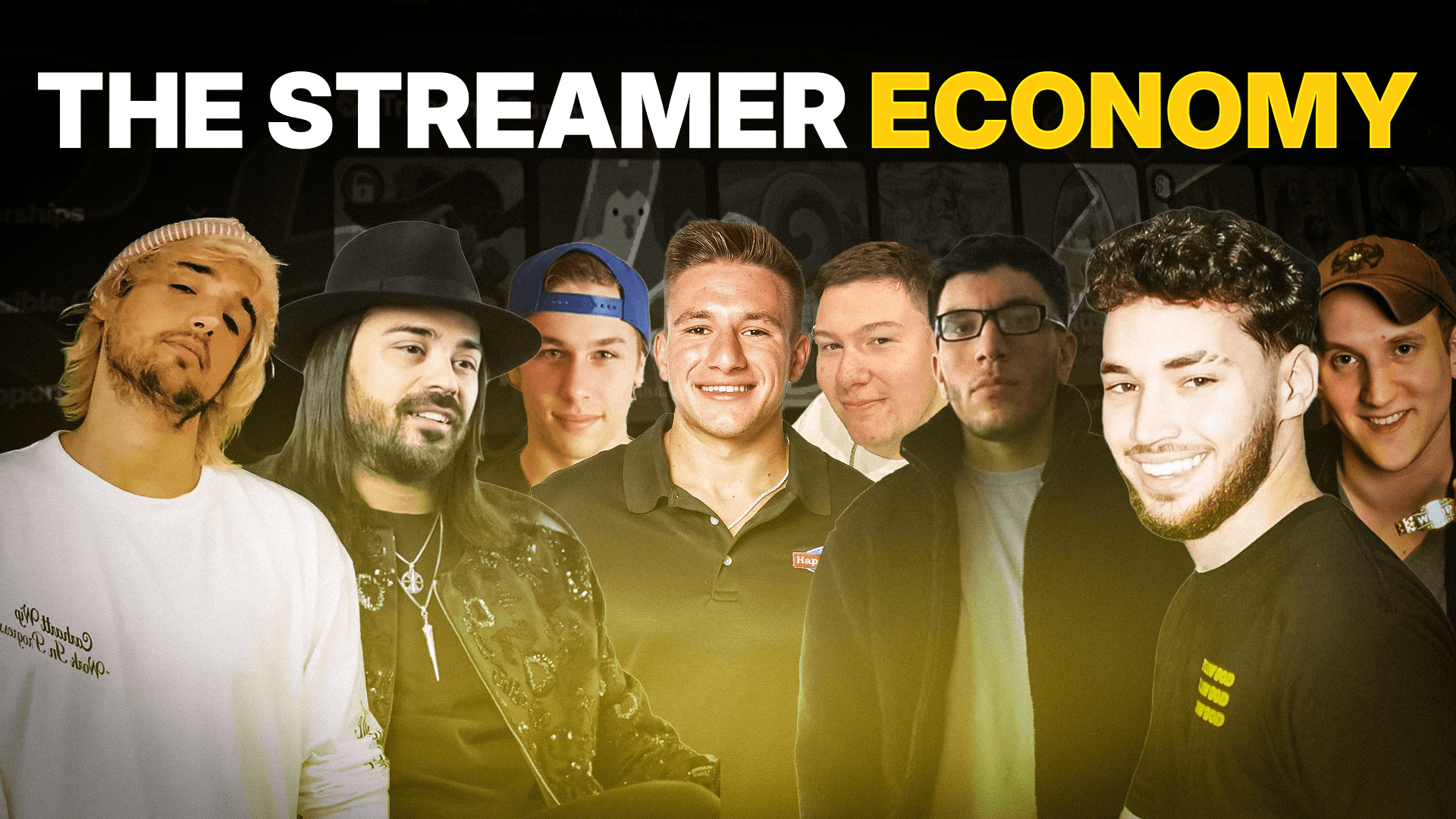
Mitch Jones says his Rainbet arrangement has grown from a $5,000 daily fill and $100 giveaways to a $350,000 daily fill. In his latest announcement on X, he also promised to give back more than half of his deal across Twitch, Discord and X. The pitch puts the audience’s share of the arrangement alongside the size of the streamer’s bankroll.
That is the business behind the headline. A casino funds the show, the show attracts viewers, and the creator builds a community around the casino. Referral codes connect that audience to the affiliate, while giveaways and recurring competitions give players a reason to stay involved.
The announcement follows a much longer shift in gambling marketing. Roobet and Stake helped bring crypto casinos into mainstream livestreaming around 2020–21. Today, the battle for creators is also a battle over who controls the relationship with the player.
The Format Started Before Roobet and Stake
Gambling livestreaming did not begin in 2020. Poker offers a clear earlier example of an operator deliberately investing in the format. In February 2015, PokerStars signed Jason Somerville and announced an official Twitch channel, with his Run It Up series helping introduce poker to new audiences.
Casino streaming also had an established audience before the crypto-casino boom. Roshtein’s own seven-year retrospective, published in February 2023, places the start of his casino streams in 2016. He described 2020 as a major growth year in which his Twitch following tripled.
These examples establish that both gambling streams and operator-backed streaming campaigns existed well before 2020. They do not establish one universal first gambling livestream. Poker, slots and other gambling formats developed along different paths.
For Roobet and Stake, the more obvious starting point is the expansion of the format into mainstream creator sponsorships. By July 2021, WIRED was reporting that both operators were paying popular Twitch personalities to play casino games. Its review found 64 of Twitch’s top 1,000 most-trafficked streamers had streamed crypto slots or advertised crypto-gambling sponsorships, with the trend gaining particular traction in April and May.
The commercial change was the audience being reached. An operator could place its product inside a creator’s existing entertainment routine, reaching people who had come to watch that personality rather than search for a casino. The stream combined a product demonstration, a recommendation and hours of repeated brand exposure.
When Casino Deals Became Headline Numbers
By October 2022, Trainwreck was claiming he had received $360 million for 16 months of gambling sponsorships, according to contemporary reporting by Tubefilter. That remains a creator’s historical claim, not an independently audited salary or evidence of his current contract.
The same month, Twitch began enforcing restrictions that named Stake, Roobet, Rollbit and Duelbits. The policy changed where those brands could appear. The subsequent birth and growth of Kick, co-founded by Stake’s founders, gave the gambling-streaming market another major distribution channel.
Platform contracts added another layer to the money being discussed. xQc’s two-year Kick agreement, announced in June 2023 and widely reported as worth up to $100 million, was a deal to stream on a platform. It should not be counted as a $100 million casino affiliate contract, nor assumed to remain his current agreement in 2026.
That distinction matters when comparing today’s announcements. A salary, an account fill, a giveaway budget, performance commissions and a streaming-platform contract can all sit around the same creator. Adding them together without knowing the terms produces a misleading picture of what the operator spends and what the creator keeps.
The Deals Shaping the Market Now
Trainwreck and Mitch Jones offer two examples with deal figures stated in their own words. Their disclosures show the scale of operator spending while also showing why the type of payment matters. Neither statement provides a full contract or audited take-home earnings.
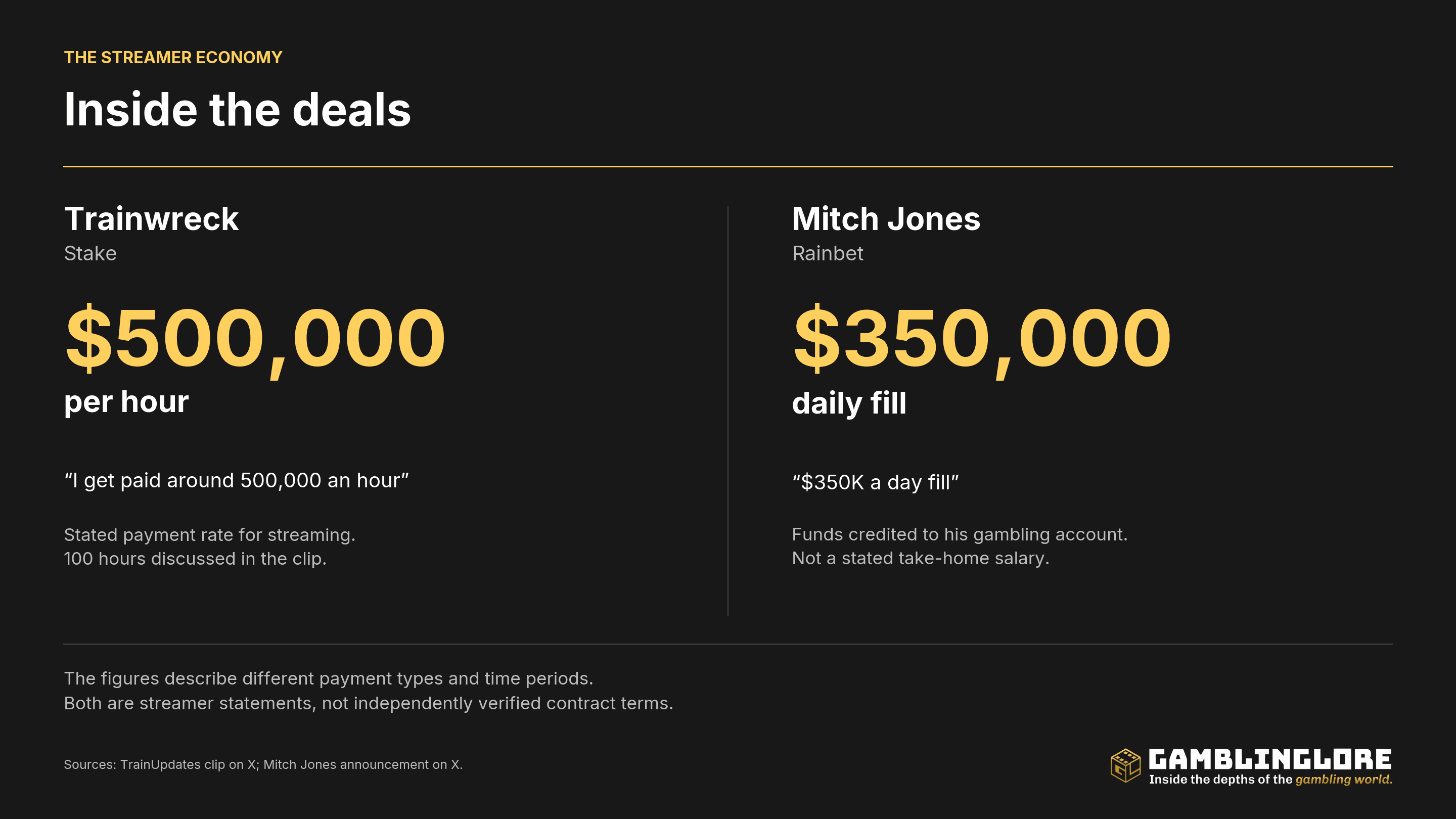
Trainwreck is the clear outlier. A July report described his stated arrangement as roughly $500,000 an hour for 100 hours, which produces the $50 million figure used in monthly estimates. His commercial role is built around high-stakes gambling as the main event. For Stake, that can mean sustained visibility among viewers who come specifically to watch casino play. The full contract and treatment of his playing funds remain private.
Mitch’s $10.5 million figure has a more direct calculation behind it: his announced $350,000 daily fill multiplied by 30 days. That describes a month of credited playing funds, not a verified monthly salary. His promise to give back more than half of the deal puts community rewards at the centre of the pitch. Rainbet gets the stream’s exposure and a creator offering viewers an ongoing reason to remain involved.
His earlier statement of $5 million a month, or $60 million a year, belongs to a previous arrangement. Neither that figure nor the $75 million total circulating on social media provides a verified breakdown of the latest deal. The daily-fill disclosure is the clearest basis for the comparison.
Adin Ross is another heavily reported massive deal. His Rainbet arrangement is at an estimated $6.5 million a month. His move from Stake in 2025 paints the picture of how an operator can buy access to a creator already familiar to a competitor’s audience. His Rainbet broadcasts continued to generate coverage in July 2026. But even when the creator performance looks good for one operator their are factors to consider when signing them, especially one of this size, and for Adin Ross his prior partnership with Stake had him pushing their US product - which aligns well with his demographic - but with the move to Rainbet their are product and jurisdiction differences that may be a barrier to Adin Ross’s following and player base. This could effect the value of the creator to the platform and should be considered when signing a deal of this size. Will the deal pencil out following a product change to the creators audience that is from a US “compliant” platform to an offshore compliant platform? Only the operator knows the answer.
These arrangements show why the operator’s buying decision cannot be reduced to follower counts. Some creators offer broad reach, others bring performance backed audiences. Those are different commercial propositions and deal size alone cannot tell us which produces the best return.
How a Viewer Becomes a Player
A streamer gives an operator access to an audience that already knows the person presenting the product. The casino is repeatedly visible during the entertainment, and a referral link or code provides a measurable route from watching to registration.
The affiliate’s value then depends on the commercial arrangement. A cost-per-acquisition deal pays for a qualifying new customer. Revenue share pays a portion of the revenue attributed to referred players. Hybrid deals combine the two. A separate sponsorship fee may pay for the creator’s time and exposure.
Rainbet Partners publicly advertises revenue share of up to 60%, alongside CPA and hybrid options. Its explanation explicitly ties affiliate earnings to referred customers remaining active and generating revenue. These are public program terms, not proof that Mitch Jones or Adin Ross receives that rate.
The calculation also differs between operators. Stake’s published casino-affiliate formula uses the game’s house edge, the amount wagered and the affiliate’s commission rate. It also says custom packages may be available. Calling every streamer arrangement a simple percentage of viewers’ losses misses these differences.
Commercially this gives an operator a reason to value a creator beyond concurrent viewers. An audience of eligible players who deposit and remain active may be worth more than a much larger audience that mainly watches. Public view counts alone cannot establish whether a deal pays for itself.
Retention Is Built Around the Creator
The relationship continues after the first deposit. A regular stream gives the community a meeting place. Discord keeps that community accessible between broadcasts. Giveaways attract attention, while wager leaderboards and tier rewards connect parts of the community’s activity directly to play.
Jones’ promotion makes that connection visible. In a June post, he advertised monthly giveaways and wager-tier rewards under his code; another promoted a $600,000 June wager leaderboard. His latest promise to give back more than half of his deal extends that same audience-first pitch across several channels.
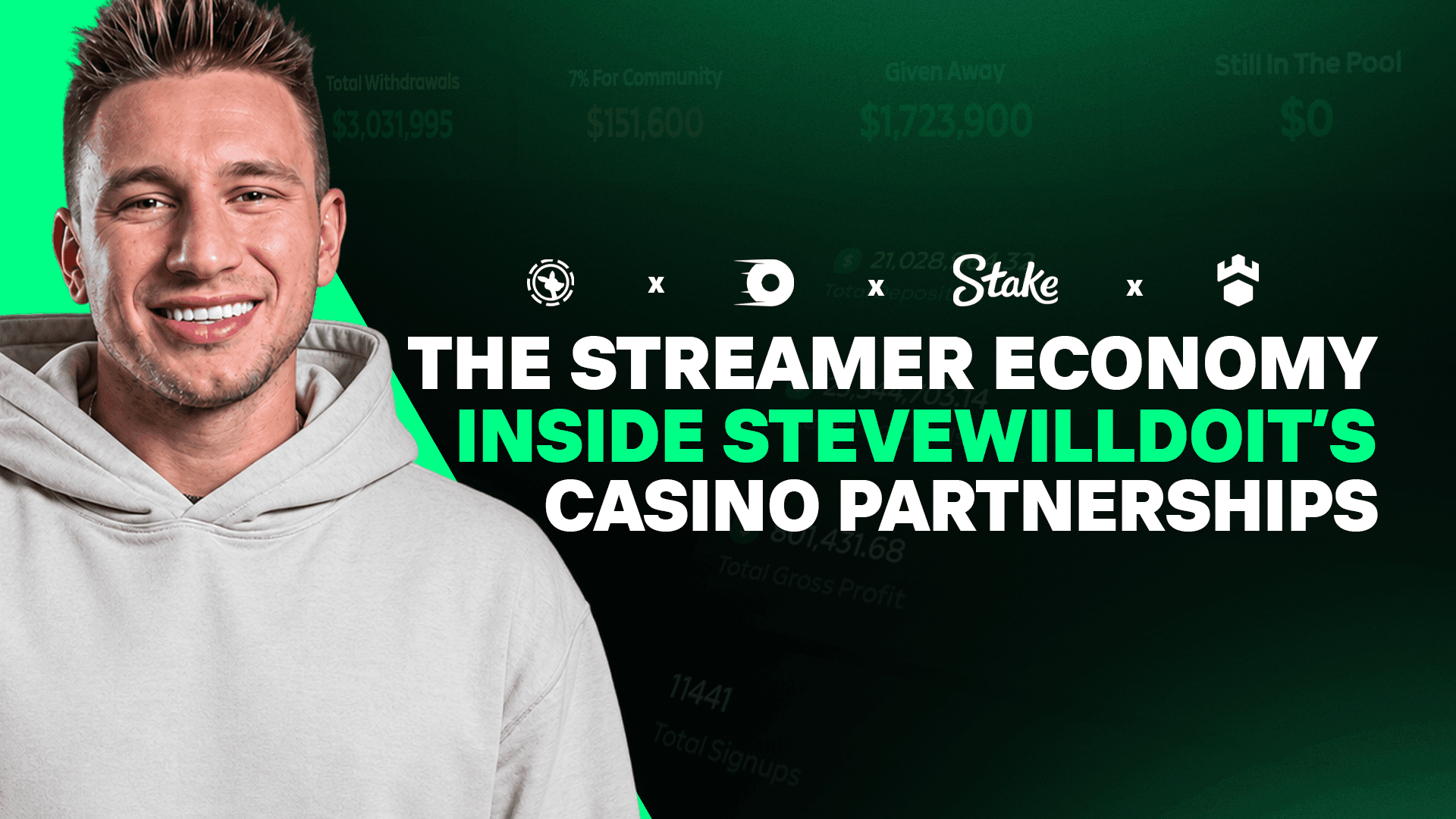
SteveWillDoIt’s current Gamdom rewards put a share of his cashouts back into the community. Through Steve Does Rewards, he commits 7% of every Gamdom withdrawal to a pool distributed through on-stream giveaways, Discord drops and raffles. The site includes a tracker for withdrawals, the community allocation and payouts, alongside a wager leaderboard. The model ties his gambling content directly to audience rewards: a cashout adds to the community pool, while giveaways and competitions give viewers reasons to stay involved between broadcasts.
The commercial interpretation is straightforward when the creator can use part of the deal to make their community more attractive to join and remain in. A player may associate the rewards with the streamer personally, even while the activity benefits the operator. That can strengthen loyalty to the affiliate’s community as well as to the casino.
These mechanisms are designed to encourage repeat activity, but public announcements do not prove how much retention they create. A giveaway entrant may never deposit. A leaderboard participant may already have been an active player. Measuring the effect requires player-cohort data, repeat-deposit rates and activity after promotions end, none of which these deal announcements disclose.
Who Keeps the Player?
The model creates attention for operators. The streamer can bring players in quickly, but some of that loyalty may belong to the creator. Ross’s move to Rainbet demonstrates that major personalities can change sponsors; it does not establish how many players followed him.
For affiliates, retaining an active community can support recurring commissions and future negotiations. For operators, the challenge is turning that borrowed attention into a lasting preference for the product. Reliable withdrawals, support and the experience on the site still matter after the stream ends.
There is also an incentive conflict at the centre of the model. Rewards tied to wagering encourage more play, and the affiliate can earn from that activity. A funded streamer’s session does not demonstrate the financial experience of an ordinary viewer. Clear disclosure of sponsorship, playing funds and reward conditions is part of understanding what is being sold.
Mitch’s announcement captures where the market has arrived. The larger deal funds a larger show and a larger promise to the audience. That promise can help acquire players, keep the community engaged and increase the affiliate’s value to the casino. The lasting question is whether the operator is building its own customer relationship or paying to remain attached to someone else’s.