NewsCreators6 min read
The Loan Meta: How Streamers Turned Millions in Gambling Debt Into Entertainment
How gambling streamers turned millions in borrowed money into entertainment and why the comeback stories they sell create a false reality for players.
 GamblingLore Editorial Desk23 August 2026


Gambling with money you don’t have was once a line no one wanted to cross. Now it has become normalized, sensationalized, and turned into entertainment.
Few streamers have done this more than TheGoobr. His streams have turned enormous gambling debts, casino markers and impossible comebacks into a recurring form of entertainment. Creating a version of gambling where losing millions is not necessarily the end of the story but the beginning of the next run.
That distinction matters because Goobr is not simply gambling with a bankroll. His publicly documented cycle involves accumulating millions in debt from casinos and individuals, continuing to gamble despite owing millions, reaching a breaking point, disappearing from the public eye, and eventually returning to chase another improbable comeback.
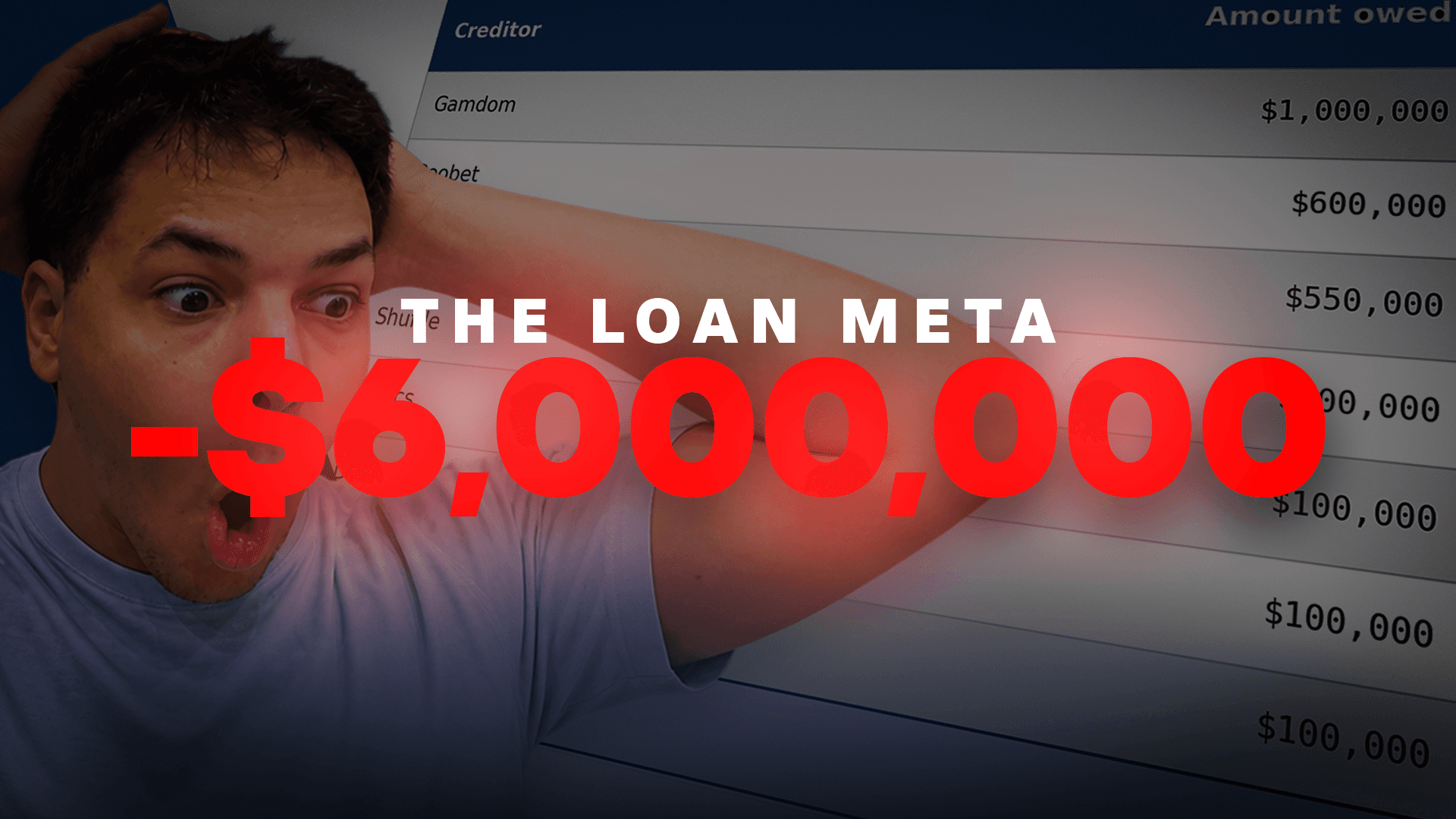
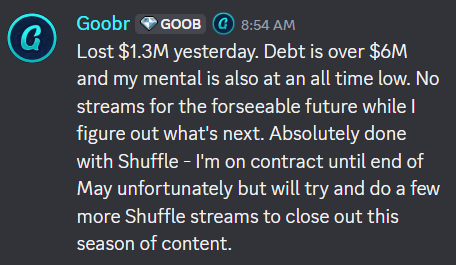
The latest chapter is the most extreme yet. Goobr recently said that he owed more than $6 million in loans, claiming that he had accumulated six-figure debts with multiple gambling operators and individuals. He described the situation himself as the "loan meta" getting out of hand.
But Goobr's situation and cycle is bigger than one streamer owing millions. It is what the cycle has done to the perception of gambling on loans.
The debt comes first. The comeback comes later.
Goobr's gambling career has followed a recognizable pattern. He gambles heavily, losses accumulate, those losses become debt, and more money is borrowed to continue playing. Eventually the debt becomes so large that continuing appears impossible.
Then he disappears.
His disappearance itself becomes part of the spectacle. His socials go dark, accounts are deleted or restricted, and viewers are left wondering what happened. It creates a massive timeline attention grab.
Then comes the comeback.
This is what makes the content compelling. A streamer sitting with $2 million of debt is not necessarily the end of the story. If he can somehow win $1 million, then $2 million, then hit a huge max win, the money owed becomes a storyline and the debt becomes a scoreboard.
That dynamic was already visible during Goobr's time with Shuffle. The timeline in November 2025 put his reported outstanding debt at more than $2 million and described a recurring cycle of winning, partially repaying loans, gambling again, borrowing again and chasing the deficit.
By January 2026 public reporting around Goobr was putting his debt at roughly $4 million. Now, with Goobr publicly stating that his casino loans have surpassed $6 million, the numbers have reached a level that would be incomprehensible to the majority of gamblers.
Yet within the streaming world, these numbers have become part of the show.
The disappearing act is part of the story
The most attention grabbing part of the Goobr cycle is not simply how much he borrows. It is what happens when the debt becomes unsustainable.
In the past Goobr has disappeared from socials after his gambling situation had worsened to similar figures we see now. In November 2025, reporting documented him deleting his X account and restricting his Discord after accumulating millions in debt while playing with Shuffle. Speculation at the time centered around whether he had simply disappeared or was preparing for another return.
And then he came back.
That is an important distinction because disappearing and returning transforms financial collapse into a storyline or narrative. The audience does not necessarily experience the debt as a permanent loss. They experience it as a cliffhanger.
Will he come back? Will he somehow win it all back? Will the next casino give him another chance? Will the next run erase the previous one?
That is where gambling stops looking like gambling and starts looking like a sports storyline. The debt is the deficit. The casino is the opponent. The comeback is the championship run. And the streamer is the star of the game.
Goobr is not playing by the same rules as his audience
This is the most important part of the conversation. The average viewer and gambler does not have access to millions of dollars in casino markers. They do not have casino operators extending six-figure or million-dollar markers. They do not have wealthy viewers willing to lend them $50,000 to continue a blackjack session.
They deposit their own money.
That money comes from a paycheck, savings, investments, or whatever disposable income they have available. If they lose it there is no sponsor waiting to refill the balance. There is no casino owner offering another marker. And there is certainly no guarantee of a comeback.
Goobr has previously demonstrated just how different this environment can be. In December 2025, a viral clip showed him asking for a $50,000 loan during a stream and losing the borrowed money almost immediately on blackjack.
That is not a normal gambling experience. It is a fundamentally different risk environment for the streamer than the viewer.
The marker has become part of the entertainment
The broader problem is not that Goobr has borrowed money. It is that the online gambling industry has increasingly made the ability to borrow money and continue gambling part of the entertainment itself.
Loan streams are no longer necessarily treated as an indication that gambling has gone too far. They can become content.
A $50,000 loan becomes a stream. A $100,000 loan becomes a clip. A million-dollar debt becomes a storyline. A multi-million-dollar deficit becomes a comeback challenge.
Even Goobr's own content illustrates how normalized the concept has become. His Kick channel has featured clips explicitly centered around loans and enormous balances, including an "entire $65K loan stream" and multiple million-dollar balance clips.
The comeback is the dangerous part
The most seductive gambling story has always been the comeback.
Lose $1,000, then win $2,000. Lose $10,000, then hit a max win. Lose everything, then somehow rebuild. Goobr takes that concept to an extreme. His audience gets to watch someone fall millions of dollars into the hole and then potentially claw his way back out. And because the comeback is possible, the debt itself can begin to look temporary.
That is where the psychology becomes dangerous.
A viewer watching a normal gambler lose $50,000 understands that the money is gone. A viewer watching a streamer lose $50,000, borrow another $50,000 and then hit a $500,000 win is watching something completely different.
The implicit message is not necessarily "gambling is safe." It is subtler: You are never truly out of the game.
There is always another loan. Another deposit. Another casino. Another run. Another comeback.
Goobr is the extreme example, not the entire problem
Goobr is simply one of the clearest examples of a much broader trend in gambling streaming: the normalization and sensationalization of extreme financial risk. The streamer economy rewards spectacle.
A $1,000 session is ordinary. A $10,000 session is content. A $100,000 session is a clip. A $1 million session becomes an event. And a multi-million-dollar debt becomes a storyline.
The more extreme the bet, the more attention it generates. The more attention it generates, the more valuable the streamer becomes. And the more valuable the streamer becomes, the easier it can become to access the financial resources necessary to keep gambling at that scale.
That creates a feedback loop:
Bigger bets → bigger losses → bigger loans → bigger comeback attempts → bigger content.
The financial risk itself becomes the entertainment.
Even the industry is calling it out
Loan culture has become so widespread and difficult to ignore that even casino owners are starting to push back. Just days ago, Stake owner Eddie Craven addressed the issue on stream, describing the current “loan meta” as “getting out of control.” He said some of the loans he has seen carry interest rates as high as 10% per day.
That culture is a byproduct of what streamers create when they turn gambling debt into entertainment. A streamer may receive a marker directly from a casino or borrow from a “friend” without paying the same interest or facing the same consequences as an ordinary gambler. The problem is that the spectacle normalizes borrowing as just another way to keep gambling
Eddie Craven later backed his position in a reply to SteveWillDoIt, who had publicly asked him for a loan. Craven responded:
“I reckon loans are probably one of the worst things you can introduce into gambling. I’d strongly recommend against offering or promoting them.”
The reality of the "loan meta"
The Goobr saga is more interesting as an example of how online gambling has changed than as a story of one streamer losing millions. Loans are now content, debt has turned into entertainment, losses have become storylines and comebacks have become something that one aspires to.
It is a dangerous combination since the typical gambler doesn't have access to the same safety net that enables these streamers stories. Goobr may lose millions and still have an audience eager to see what happens next, whereas the ordinary player loses their own money.
For them there is neither a sponsor, nor a casino marker, nor a millionaire friend, nor a comeback stream ahead. All they have is the loss and the consequences that come with it.