InterviewsCrypto Casinos17 min read
When Every Casino Looks the Same: Mike Danshin on Building a Crypto Gambling Contender
Mike Danshin is helping guide 1win’s evolution from an established fiat betting brand into a global crypto contender. He discusses the lessons shaping that transition.
 Interviewed and written by supr3me21 August 2026


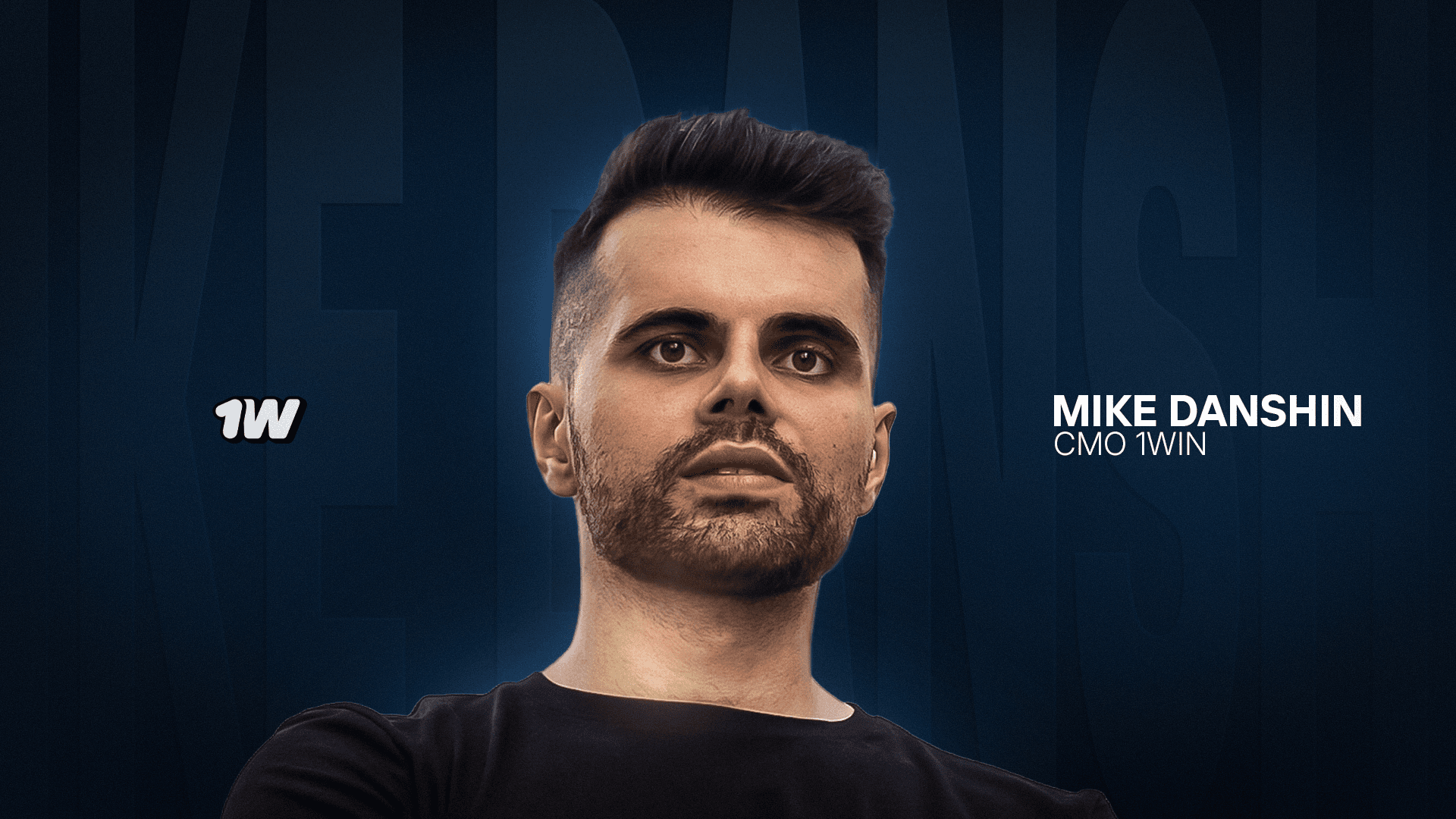
Mike Danshin describes himself as a boring marketer. He means it as a compliment.
For all the language of instinct, virality and creative disruption that surrounds crypto marketing, Danshin would rather begin with attribution, testing and scale. He wants to know where a user came from, what that user did next and whether the same result can be repeated with ten times the budget.
That discipline was not always available to him.
When Danshin joined 1win, the company was already established in fiat gambling but had not yet built the same position in crypto. One of his first assignments was to market its Telegram mini app during the rush that also produced Notcoin, Hamster Kombat and dozens of similar products.
The market was moving faster than the available tools. Campaigns could generate users, but attribution between a Telegram source and activity on 1win was incomplete. Geographic targeting was inconsistent. Bot traffic was common. Benchmarks barely existed.
The team moved anyway.
According to Danshin, the app reached 24 million monthly active users within several months.
MIke Danshin: It was really a leap of faith.
We did not have deep analytics. We did not know which sources would work and which would not. We had to find the players first and build the analytics on top of that.
The rest of his career has been a long study of that relationship: when to move before the numbers are complete, when to stop trusting an attractive result and how to turn player behaviour into a marketing system that can scale.
The timeline
Early 2010s
Danshin begins betting on football as a teenager and studies probability, live-betting strategies and arbitrage.
2016
He enters affiliate marketing through betting content and social media.
2017
He joins a sports media company, helps develop Betting Insider and rises to marketing director.
Before 2020
Danshin launches a marketing agency serving land-based casinos.
2020
The agency closes after COVID-19 restrictions shut down its client venues.
2021
He joins BetBoom, first working in the CIS region and later focusing on Latin America and Brazil.
2024
Danshin joins 1win to help lead its transition from fiat into crypto.
2024
The 1win Token Telegram mini app launches during the Telegram gaming boom and, according to Danshin, reaches 24 million monthly active users within several months.
2024-2026
His work expands into influencer marketing, X, Discord, Reddit and the broader positioning of 1win Crypto.
Present
1win prepares a gambling token intended to connect its Web2 audience with a Web3 product and investment model.
The bettor before the marketer
Danshin's interest in gambling began long before it became his career.
He says he started betting on sports at around 13, using early mobile phones and watching as much football as television schedules allowed. By the time he was old enough to open a Bet365 account, the question was not whether he would sign up, but whether the site would accept him on his birthday or make him wait another day.
It was not purely casual.
Danshin read books about probability and betting strategy. One of his approaches followed the 80 percenter handbook, specifically he would find football matches that remained scoreless after 15 or 20 minutes despite one side dominating possession and shots, then betting on a goal before half-time.
He remembers Saturdays spent following several matches at once through Bet365's multi-view interface, looking for the right conditions.
Mike Danshin: At that point, I thought I could be successful against the bookmaker.
For a period, he pursued arbitrage betting, placing opposing bets across different bookmakers to lock in a return regardless of the outcome. Accounts were limited or closed. The work demanded constant attention.
Eventually, university-level mathematics and statistics did not convince him that beating bookmakers was impossible. They convinced him that doing it consistently would require treating betting as a full-time profession.
The financial reward did not justify the psychological cost.
Mike Danshin: I realised that I could be successful, but I would have to dedicate my life fully to betting and gambling
I was not ready to do that. The only option was to treat it as fun.
That personal experience would later become one of his main professional advantages.
Building a betting community before social betting had a name
Danshin entered affiliate marketing in 2016 through social media and betting predictions.
He ran a public page that published tips before joining a large sports media company to manage its betting section. The team eventually built Betting Insider, a product he describes as a social betting network before that phrase was widely used.
Users could discuss football, publish predictions, place virtual bets and compare performance through rankings and statistics.
Danshin rose to marketing director, managing a large team and learning how traffic, affiliates and bookmaker partnerships fit together.
The product also taught him the limits of competing for the same audience as better-funded operators.
Betting Insider began in the CIS region, where licensed bookmakers could generally pay more to acquire users. The team found an opening on Android because Google Play restricted official betting apps at the time. Danshin says Betting Insider reached between 70,000 and 80,000 organic installs per month with limited paid marketing.
Apple was more difficult. Betting apps were already present, and the available traffic was harder to reach after the bookmakers themselves.
The lesson was early but durable: distribution rules can matter as much as the product.
From land-based casinos to a global operator
After Betting Insider, Danshin started a marketing agency serving land-based casinos.
It was his first experience of being responsible for more than marketing. He also had to think about operations, finance, legal documents and the survival of the business itself.
The agency closed during the COVID-19 lockdowns, when its clients could no longer operate normally.
Danshin then spent roughly three years at BetBoom. He began with the CIS region and later worked on Latin America, particularly Brazil. He credits the period with teaching him how a brand and its marketing have to change when they leave their original market.
Land-based casino marketing had been built around entertainment as much as gambling. Danshin recalls events where casinos paid major performers as much as $1 million for a single night. The goal was not simply to put a gambling offer in front of an existing player. It was to create a reason for a wider group to travel, socialise and stay inside the venue.
Online marketing had a different scale.
At 1win, the audience stretched across Latin America, Asia and the CIS. The challenge was no longer to make one physical property attractive. It was to make one product feel local across markets with different languages, payment methods, games and expectations.
Why transforming a company is harder than starting one
Danshin joined 1win roughly two years before the interview.
He says it was a deliberate attempt to move beyond his regional experience and work on a genuinely global product. The company had an operating history dating to 2016 and an established fiat audience. His job was to help build the crypto side.
That sounded easier than it was.
Mike Danshin: Creating a new crypto product from scratch is easier.
When you move from fiat to crypto, you have to adapt the product, the marketing, the communications and the team as well.
A new company can design itself around crypto from the beginning. An existing one has habits, systems and an audience that cannot simply be discarded. The opportunity at 1win was that Danshin could combine the freedom of a startup with the resources and experience of a mature operator.
His thesis is not that crypto should replace fiat completely. It is that an operator should let customers use whichever form of money is already convenient for them. A freelancer may receive part of an income in crypto and the rest through a bank account. Forcing that person to convert funds before playing creates friction without adding value.
The advantage of 1win's history, in his view, is the ability to serve both behaviours inside one brand.
He was also able to narrow his own role.
Running an agency had forced him to manage everything. At 1win, specialists could handle finance and operations while he concentrated on marketing.
Mike Danshin: Marketing is the thing I enjoy most. I can be successful in marketing, but I do not see myself being successful in finance.
You should delegate an area to professionals when they can do it better.
The 24 million-user leap of faith
One of Danshin's first major assignments was marketing the 1win Token Telegram mini app.
The product arrived during a period of intense excitement around Telegram games. The basic playbook was visible across the market: build a lightweight game, exchange or buy traffic, grow the user base rapidly and then find a way to monetise it.
Some apps sold ads or traffic. Others used subscriptions. 1win's strategy was to build an ecosystem that could move a portion of the Telegram audience into its main gambling product.
According to Danshin, roughly 60 to 65 percent of the app's traffic came from exchanges and purchases involving other Telegram mini apps. Another 10 to 15 percent came from Telegram ads, around 5 percent from paid posts in crypto channels, with the balance coming from affiliates and platforms such as Facebook and Google.
The headline number grew quickly. The understanding beneath it did not.
The team could see users arriving at 1win from a given country, but it could not always connect those users back to a specific Telegram campaign. If a campaign targeted Turkey and registrations from Turkey increased, the relationship appeared obvious, but it was still partly an inference.
Bot traffic created another problem. Some sources could deliver large volumes without geographic controls. Markets such as Turkey and Indonesia performed well, Danshin says, while some traffic bought in India and parts of Africa produced little value.
There was also heavy overlap between the mini apps. The same highly active Telegram users could appear across five, ten or fifteen products.
Mike Danshin: We were guessing.
We could see that we had a thousand users from one country, but we did not know which source gave us those players. I created the analytics for this product from scratch.
For Danshin, the claimed 24 million monthly users did not settle the strategic question of what those users meant.
Volume without attribution could still hide weak economics.
When instinct is not enough
Danshin does not present the Telegram campaign as a model for ignoring measurement.
The team moved early because the window was closing. Hype made speed a competitive advantage, and waiting for a perfect analytics system could have meant arriving after the audience had already been divided among other apps.
That exception made the rule clearer.
Mike Danshin: I am a boring person. Analytics and testing a marketing channel are my first priority.
My instinct is not exceptional. What helps me is that I have seen a lot in this industry.
Experience can help a marketer decide where to test. It cannot replace knowing whether the result can scale.
Danshin says he regularly sees gambling products with five, ten or fifteen valuable players and no reliable way to find more of them. A campaign may look excellent at a small budget, but if the available audience disappears as soon as spending increases, it is not a growth engine.
The first users are usually the easiest and the most loyal. Each additional million becomes more expensive.
The relevant question is not only whether a channel worked. It is whether it can keep working.
Influencer marketing as a trust system
Danshin's work later moved from Telegram into influencer marketing and social media, including X, Discord and Reddit.
He describes influencer marketing as one of the simplest and most honest ways to build a community because the reaction is immediate. A creator's audience will expose product weaknesses, question the offer and make clear what matters to them.
The value depends on a genuine match between the brand and the person promoting it.
A current football star with global sponsors may have the larger audience, but gambling may be their fourth priority. They might agree to one post, avoid anything more visible and leave the brand with an expensive asset it cannot activate.
A retired or less famous player may be far more useful if they create their own content, talk directly to followers and are willing to build the campaign with the operator.
Mike Danshin: Both sides have to understand the value of the campaign and be ready to work together.
I have seen many deals where one side was simply not ready to activate the contract.
He also draws a sharp distinction between performance marketing and brand investment.
Performance campaigns can be judged on first-time depositors and acquisition cost. Ambassadors and sponsorships are intended to build recognition, trust and status, particularly among higher-value players. Measuring them against an immediate CPA target misunderstands the job they were hired to do.
A famous ambassador is also a signal to the market. The operator is showing that it can afford the association.
The campaigns that taught him the most
Not every expensive lesson produced 24 million users.
Danshin says 1win lost as much as $200,000 in one incident involving a Telegram mini app that failed to deliver what had been agreed. At the height of the market, there was no reliable institution of reputation for these products. Operators were buying reach inside a system that had not yet built strong safeguards.
Reddit produced a different kind of failure.
The team tested agencies, internal campaigns, its own subreddit, search-focused content and AI-assisted approaches. Danshin says only a small part of the effort produced useful results. Gambling content was repeatedly removed, and established accounts could be banned alongside new ones.
Other campaigns looked ineffective before eventually producing value.
Paid reviews in Japan and South Korea sometimes carried an implied cost per click above $100 because the sites appeared to have limited traffic. Months later, a small number of valuable players emerged.
The problem was not proving that those campaigns could work once.
It was finding enough comparable sites to make the result repeatable.
Mike Danshin: After a year or a year and a half, there were some VIP players.
But I still do not know how to scale that marketing channel. It was one Japanese website or one Korean website, and that was it.
When every casino looks the same
Danshin believes launching a casino has become technically easier while building a defensible one has become harder.
White-label platforms can reproduce the familiar structure quickly: the same providers, similar slots, similar original games, similar bonus systems and similar betting interfaces.
He estimates that 80 to 90 percent of the product is shared across much of the market.
That does not mean product has stopped mattering. It means the work has moved into less visible details.
The next advantage is local adaptation.
A product for Egypt cannot simply be the same interface translated into Arabic. It has to work naturally from right to left, support local payments, offer the games people in that market actually play and connect to communities that already exist.
India creates a different set of requirements. Latin America requires another.
Mike Danshin: In 2026, you cannot just run one global product.
If you do not adapt, your acquisition cost will be higher than the local brands. You will pay more for the same traffic and lose against your competitors.
Sports betting makes the similarity especially visible. The odds and events can resemble a spreadsheet. Most casual users will not calculate the difference across a seven-leg accumulator.
What they notice is the brand, the experience, the streams, the payments and the way the operator speaks to them.
The gambler inside the CMO
Danshin says one of his professional advantages is simple: he still gambles.
He does not spend hours calculating every bonus or move between operators for a marginally better price. Convenience and fast withdrawals matter more to him than changing from odds of 1.90 to 1.95 or finding a slot with a slightly higher theoretical return.
That places him closer to the casual player than the bonus optimiser.
The distinction matters when teams design campaigns.
A marketer who does not gamble might build a wagering leaderboard and assume every player will be motivated to participate. A casual player may look at the same promotion, conclude immediately that the highest-volume users will win and ignore it.
Mike Danshin: They do not know the psychology.
As a casual player, I know I will never win that kind of tournament. You have to find ways for casual players to win sometimes.
The same difference appears in discussions of RTP.
For a player wagering for several hours every day, a small mathematical difference can matter. For someone playing on a phone for 15 or 30 minutes, volatility will often shape the experience more than a difference between 94 and 98 percent RTP.
A high-RTP game can still feel unrewarding if wins are rare. A lower-RTP game can feel active over a short session.
Danshin believes casual players are more likely to care about the welcome offer, transaction speed, community and whether the product is entertaining.
The mathematics matter. They do not describe every reason a person returns.
The Baggage of The Industry
The interview eventually moved to the criticism that follows crypto casinos: delayed withdrawals, scam accusations, weak safeguards and the broader objection that gambling companies profit when customers lose.
Danshin's answer begins with personal autonomy.
He says he has gambled since adolescence, used money he earned himself and never felt a conflict about working in the industry. His rules are direct: do not borrow to gamble, do not risk money you cannot afford to lose and do not treat gambling as an income plan.
Mike Danshin: People should treat gambling as entertainment, not as their source of income.
He argues that gambling is judged more harshly than other forms of entertainment built around repeated spending. At the same time, his defence leaves a hard question for operators.
If personal responsibility is the principle, the product still has to give the player the practical ability to exercise it.
Danshin says the industry needs to care more about reputation and present gambling honestly. He accepts that some criticism of 1win is measurable and fair. He cites betting odds as one example: if an independent comparison shows another operator offering better prices, the company should not pretend otherwise. It has to compete through another part of the offer or improve.
Reputation cannot be defended only through marketing. It has to survive comparison with the product.
Gambling tokens and the next consolidation
Danshin expects two forces to shape the next stage of crypto gambling: tokens and consolidation.
His token thesis is based on a perceived imbalance. Crypto casinos generate significant real revenue and serve large communities, yet gambling tokens occupy a relatively small part of the wider crypto market.
He believes tokens can connect two audiences. Web3 users can trade and use them inside the product. Existing Web2 customers gain a way to take financial exposure to a gambling company in a sector where few operators are publicly listed.
That is the logic behind the planned 1win token.
Mike Danshin: The community is real. The players are real. The income is real.
Why should the market for gambling tokens be so small?
The second force is consolidation.
Launching a new casino may be faster than before, but Danshin does not believe players need an endless number of nearly identical operators. Stronger companies will absorb weaker ones, while new challengers will still emerge in markets the current leaders have not served well.
He repeatedly returns to India as an example of a large market where crypto adoption, remittances, gambling demand and restrictive laws intersect in complicated ways. In his view, a company that solves that market locally could become a global top-five operator from one country alone.
His broader prediction is less geographic.
The winners will be fast, honest about their data and diversified across channels and regions.
How 1win thinks it can challenge Stake
Danshin is direct about 1win's ambition.
He believes it can eventually become the largest crypto gambling brand, overtaking Stake.
His case is not that Stake lacks money, recognition or a proven product. It is that even the market leader has areas where a competitor can be more effective.
Danshin points to affiliate operations, link management and reporting as one opening. He argues that 1win can provide a stronger experience for some performance partners and use that advantage to narrow the acquisition gap.
He sees another opening in how sponsorships are activated.
His football experience taught him that placing a logo on a shirt or website is not enough. The operator has to work with the fan base through events, content, benefits and participation on the ground.
Mike Danshin: Football is more than business. It is passion.
You cannot add your brand to the shirt and forget about everything. That campaign will not be successful.
He also claims 1win's betting product offers more outcomes and live streams than Stake, though he accepts that competitors can hold advantages elsewhere.
The strategy is not to win every comparison at once.
It is to identify where the leader is weakest, compete there aggressively and improve the return generated by the same marketing budget.
The introvert who learned to network
For someone whose career depends on audiences and relationships, Danshin describes himself as an introvert.
Networking did not come naturally. He chose roles that forced him to improve at it.
At BetBoom, he began as head of communications partly because he understood that relationships, conferences and a professional network would become essential as he moved toward senior leadership.
Mike Danshin: Working with people, mentoring them and maintaining good relationships was not native for me.
I worked on it a lot. I hope it paid off.
Social media made that work easier and more difficult at the same time.
The old internet allowed people to enter a forum, participate and leave. Modern platforms make everyone continuously reachable. Messages, calls and notifications can interrupt any part of the day.
Danshin's answer is selectivity.
Access to more people is valuable only if the noise does not consume the attention required to do the work.
What Football Manager taught him about teams
The interview ended where Danshin's career began: football.
He follows Everton and enjoys visiting smaller grounds with a strong local identity. A recent trip to Fulham's Craven Cottage stayed with him because the stadium still carries the shape of its history. What began as a cottage became a football ground and then a valuable Premier League business without losing its sense of place.
He hopes to own a lower-league football club one day.
Until then, he has Football Manager.
Danshin says he has spent thousands of hours playing the game since 2006 and has borrowed parts of its squad-building logic for his work.
Not every employee needs the same role or the same path. Some people need to become stars. Some are comfortable as reliable substitutes. Others are young talents who require more attention and a visible route to development.
Mike Danshin: I treat my team like a football squad.
Some people should be stars, otherwise they will move to another company. Some are comfortable in supporting roles. Some are young stars, and you have to follow their development every day.
The analogy is not perfect.
Its value is that it makes one management principle difficult to ignore: a team is not improved by treating every person as interchangeable.
From betting instinct to marketing infrastructure
Danshin entered gambling believing he might beat bookmakers by studying harder than the average player.
His career gradually moved him to the other side of the interface.
There, he discovered a similar lesson.
An operator can win a campaign through timing, instinct or one exceptional partner. It can reach millions of users before its measurement is complete. It can find a valuable player on a site that appeared too small to matter.
None of those moments automatically becomes a system.
The system begins when the company understands why the result happened, who produced the value and whether the result can be repeated.
When the products and the marketing channels are almost the same, the differentiator is how you treat your data.
That may be the clearest connection across his story.
Betting Insider found distribution where bookmakers could not list their apps. The Telegram campaign moved before the analytics existed. Influencer partnerships work when both sides activate them. Local products reduce the acquisition disadvantage against local competitors. Personal experience helps a marketer recognise how a player will interpret an offer.
The opportunity is rarely hidden in one new feature.
It is hidden in the relationship between the product, the audience and the information that connects them.
Closing note
The most useful part of Danshin's story is not the 24 million-user figure by itself.
It is what the number failed to answer.
Audience scale did not identify which sources created valuable players. A successful campaign did not explain whether it could be repeated. A global product did not remove the need to understand local markets. A famous ambassador did not guarantee that a partnership could be activated.
The marketing industry often celebrates the visible result and treats the infrastructure beneath it as a secondary concern.
Danshin's experience suggests the reverse.
The visible result creates an opportunity. The infrastructure decides whether the opportunity survives.
Continue reading
- Related analysis:1win Analysis: The Playbook Behind Its Global Expansion